

If your baby seems too low, bring their nose level with your nipple and support their whole body, not just their head, before you attempt the latch. Use a pillow, rolled towel, or structured nursing support to close the height gap rather than hunching forward yourself. Getting this height right is what stops a shallow latch and the nipple pain that so often comes with it.
TL;DR:
- Proper support and positioning can significantly improve latch depth, reducing nipple pain and making breastfeeding more comfortable.
- Using a structured nursing pillow or support underneath the baby ensures consistent height, preventing shallow latch caused by low positioning.
- Repositioning should be checked at each feed before baby becomes distressed, especially focusing on nose-to-nipple alignment and overall body support.
- Signs of persistent positioning issues include ongoing nipple damage, baby not gaining weight, fewer wet nappies, or signs of distress requiring professional help.
- Repeated low positioning can lead to long-term breastfeeding problems, such as slow weight gain and early weaning, if not corrected early.
Table of Contents
- Why does a low position cause breastfeeding problems?
- What holds and supports actually raise baby to the nipple?
- How do you set up a feed to get the height right?
- When should you get professional help for positioning?
- Can tongue-tie or oral anatomy affect latch height?
- How do you fix the latch mid feed if baby slips too low?
- Does frequent low positioning cause long-term breastfeeding problems?
- How can you stop the low position happening before every feed?
- Small habits that stop the low position problem for good
- Bringing baby to the right height without the guesswork
- Sources
- FAQ
Why does a low position cause breastfeeding problems?
When a baby feeds too low, their neck usually tilts back or twists sideways to reach the nipple. That angle makes it hard for them to open wide and take in enough breast tissue, so instead of a deep, comfortable latch, they end up gumming the nipple tip. This is one of the most common causes of a shallow latch, and a shallow latch is a leading driver of nipple pain and, over time, early weaning.
You’ll usually notice the problem before baby does. Watch for these signs during a feed:
- You’re hunching or leaning forward to reach baby, rather than baby coming up to you
- Baby is stretching or craning their neck upward to reach the nipple
- Their chin isn’t resting into the breast
- You hear clicking or smacking sounds as they feed
- There’s sharp or persistent nipple pain, especially at the start of a feed
- Feeds are dragging on longer than usual, or baby seems to work hard without settling
A correctly positioned baby lets you look straight into their eyes, with ear, shoulder, and hip roughly in line. When that alignment’s off, milk transfer often suffers too. Baby works harder for less milk, gets frustrated faster, and may need more frequent feeds to make up the shortfall. None of this means you’re doing something wrong. It usually just means the setup needs a small height correction.
What holds and supports actually raise baby to the nipple?
There’s no single position every mother must use. The Australian Breastfeeding Association is clear that comfort for both of you matters more than following one prescribed method. What does matter is avoiding the hunch. Bring baby up to breast height instead of folding yourself down to meet them.
A few holds make that easier than others:
- Laid-back position. Recline on a supportive chair or with pillows behind you, and lay baby chest-down on your body. Gravity and baby’s own reflexes often do the positioning work for you, which is handy for a sleepy or fussy newborn who’s fighting the latch.
- Cross-cradle hold. Support baby’s head and shoulders with your hand (opposite arm to the feeding breast), which gives you fine control over the angle and height as you bring them in.
- Rugby hold. Baby tucks under your arm on the same side as the feeding breast, which works well after a caesarean and gives you a clear view of the latch.
- Side-lying position. Lie facing baby with their mouth level to your nipple. It’s low effort for night feeds or when you’re recovering and want to stay lying down.
For all of these, the actual lift usually comes from what you put underneath baby, not the hold itself. A folded towel adds quick height in a pinch. A rolled blanket gives a bit more shape but can flatten under baby’s weight during a longer feed. A structured nursing pillow holds its height and shape consistently, which matters most in cross-cradle and rugby holds where baby’s whole body needs steady support, not just a boost under the head.
Whichever support you choose, check the basics every time: baby’s airway stays clear, their chin is tucked slightly rather than jammed into their chest, and their hips and shoulders are supported, not just dangling off the edge of the support.
Pro Tip: Keep whatever support you’re using within arm’s reach before you sit down to feed, not after baby starts rooting. Fumbling for a towel mid latch attempt usually undoes the position you just got right.
How do you set up a feed to get the height right?
A good setup takes less than a minute once it’s a habit. Working through it in order stops the most common mistake, which is trying to fix baby’s height after they’re already latched and unsettled.
- Sort yourself out first. Get back support, a small footrest if your feet don’t sit flat, and loosen anything tight around your chest.
- Place your support at the right height. Baby should lie on it so their nose sits level with your nipple before they even open their mouth.
- Bring baby in chin-first. Tilt their head back slightly so the chin leads and the nose is clear, aiming for a wide-open mouth and an asymmetric latch (more of the bottom of the areola in their mouth than the top).
- Check it’s working. Listen for rhythmic swallowing, watch for rounded cheeks and a chin pressed into the breast, and make sure there’s no sharp pain.
- Still too low? Adjust again. Increase the height of your support, pull baby’s hips in closer to your body, or switch to a hold that gives you more control, like cross-cradle.
Feed frequency matters here too. Newborns typically need 8 to 12 feeds a day, and getting the position right at each one adds up over a day of feeding. Getting it wrong repeatedly is what turns a one-off sore latch into ongoing nipple damage.
If you’ve run through this checklist a few times and baby still won’t stay at the right height, it’s worth trying a different hold entirely rather than persisting with one that isn’t working for your body shape or baby’s size.
When should you get professional help for positioning?
Most positioning issues resolve with small adjustments over a day or two. But certain signs mean it’s time to bring in a lactation consultant, midwife, or GP rather than keep troubleshooting alone.
- Nipple pain or damage that doesn’t ease despite repositioning
- Baby isn’t gaining weight as expected at check-ups
- Fewer wet nappies than expected for their age
- Lethargy, or baby seeming unusually sleepy and hard to rouse for feeds
- Choking, gagging, or persistent distress at the breast
If you’ve tried the practical fixes and there’s no improvement within 24 to 48 hours, or any red flag appears sooner, don’t wait it out. A lactation consultant assessment usually involves watching an actual feed, hands-on repositioning while you’re latched, a weight check, and a referral for tongue-tie or other oral issues if those are suspected. That hands-on observation catches things a mirror or a guide simply can’t.
Can tongue-tie or oral anatomy affect latch height?
Sometimes the height is right and the latch still doesn’t work. That’s usually where oral anatomy comes into the picture. A baby with tongue-tie (where the strip of tissue under the tongue restricts movement) often can’t extend their tongue far enough to draw the nipple deep into their mouth, no matter how well you’ve positioned them. The result looks a lot like a low-position latch: shallow attachment, clicking, and nipple pain, even though the setup itself is correct.
Other oral anatomy issues, like a high or narrow palate, a receding chin, or a shorter jaw, can produce the same pattern. Baby compensates by biting down closer to the nipple tip rather than drawing in the areola, which mimics exactly what happens when they’re fed too low.
This is precisely why hands-on assessment from a lactation consultant matters when repositioning alone doesn’t fix things. Height and support solve a mechanical problem. They can’t solve an anatomical one. If you’ve worked through every hold, checked your support, and adjusted the angle repeatedly without any change in pain or feeding efficiency, tongue-tie or a related oral issue is worth ruling out before you assume you’re simply “doing it wrong.”
How do you fix the latch mid feed if baby slips too low?
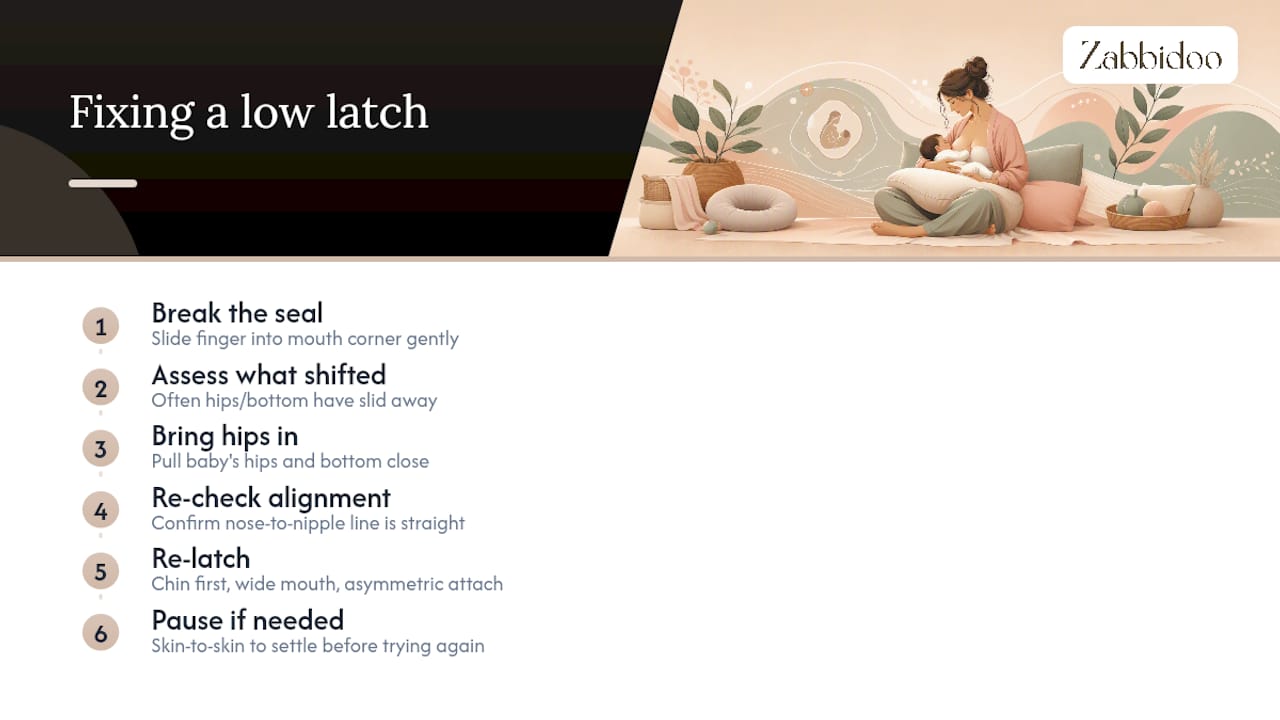
Baby can start well positioned and drift low partway through a feed, especially once they relax and their body sags on the support. You don’t need to start over completely. Slide a finger gently into the corner of their mouth to break the seal first, rather than pulling them off while still latched, which can drag on the nipple and cause more pain.
Once the seal’s broken, check what’s actually shifted. Often it’s simply that baby’s hips have slid away from your body, dropping their whole alignment down and back. Pull their hips and bottom in close to you again, not just their head, then re-check that nose to nipple line before trying the latch again.
If the support underneath has flattened or shifted during the feed, that’s your answer right there. This is the exact problem a compression resistant nursing pillow is built to prevent. Soft pillows and folded towels tend to lose height under sustained weight over a 20 or 30 minute feed, which is often why baby starts well and ends up low.
Re-latch the same way you did the first time: chin leading, wide mouth, asymmetric attachment. If baby’s upset or has been chewing on a shallow latch for a while, a brief pause for some skin to skin contact can help them settle before you try again, rather than pushing straight back in while they’re frustrated.
Does frequent low positioning cause long-term breastfeeding problems?
Sore nipples from one poorly positioned feed are annoying but temporary. The real risk shows up when low positioning becomes the pattern rather than the exception. Persistent shallow latching, feed after feed, tends to compound in a few predictable ways.
Nipple damage that doesn’t get a chance to heal between feeds gets worse, not better, and pain that intense is one of the most common reasons mothers give up on breastfeeding earlier than they planned to. On top of the pain, a baby who’s chronically latching shallow usually isn’t transferring milk as efficiently, which can mean slower weight gain and a mother whose supply drops because demand at the breast hasn’t been strong enough.
There’s also a learning curve for baby. Babies who repeatedly practise a shallow latch can settle into it as their default, making the deeper latch feel unfamiliar even once positioning improves. That’s not a reason to panic over the odd rough feed. It’s a reason to fix the pattern early, in the first couple of weeks, rather than assume it’ll sort itself out.
How can you stop the low position happening before every feed?
Prevention beats correction here, mostly because it’s far less stressful to set up properly than to fix a screaming, frustrated baby mid feed.
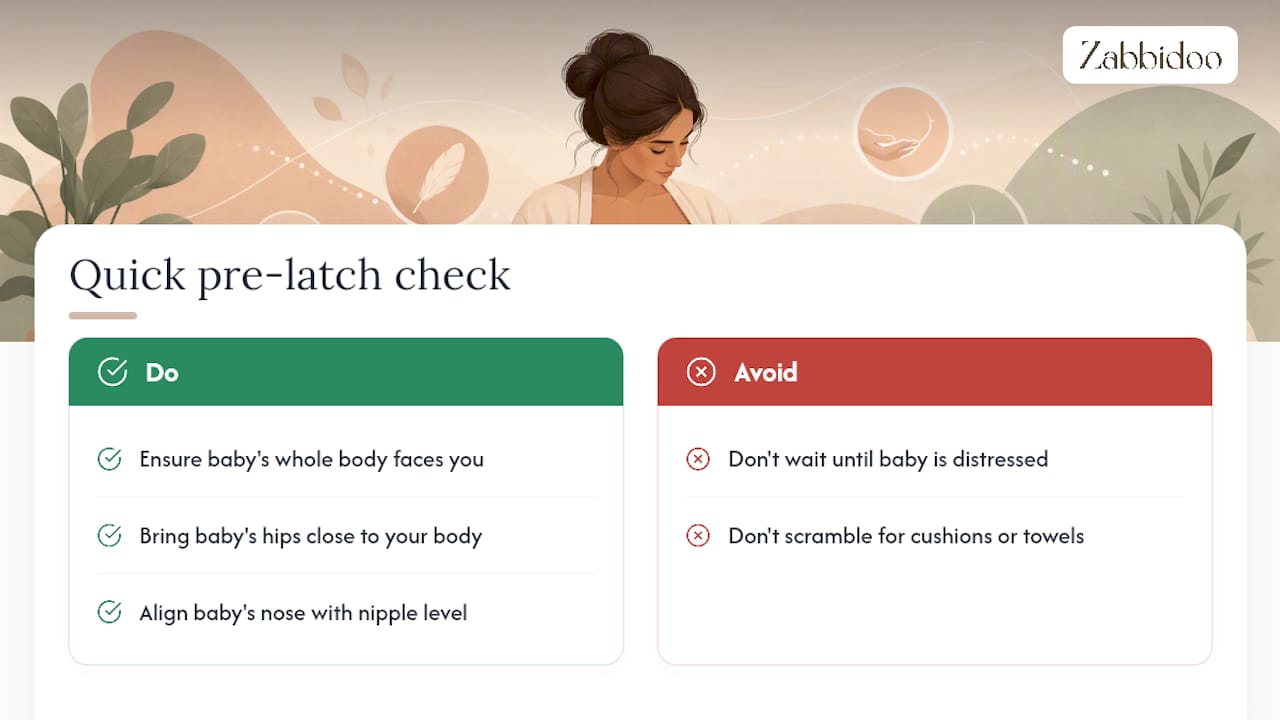
Before baby even signals hunger, get your own setup sorted: back supported, shoulders relaxed, whatever nursing support you use already in position at the right height. Watch for early hunger cues (rooting, hand to mouth, stirring) and start the position while baby’s still calm, rather than waiting until they’re distressed and arching away from the breast.
Keep the same support in the same spot near your feeding chair or bed, so there’s no scramble to find a towel or cushion once baby’s rooting hard. Consistency here does a lot of the work. If you always feed from the same setup, you stop relitigating the height problem at every single feed.
Finally, do a quick body check before latch, not after: is baby’s whole body facing yours, hips close in, nose at nipple level? That ten second pause, done every time, prevents most of the low positioning problems this article covers.
Small habits that stop the low position problem for good
Most mums fix this within a few feeds once they know what to check for. It’s rarely a sign of poor technique. It’s usually just a height gap that’s easy to close once you’re looking for it.
What actually helps long term isn’t perfect technique every single time. It’s a small set of habits repeated often enough that they become automatic: a support cushion that lives near your feeding spot, a quick posture check before baby latches, and a couple of holds you’ve practised enough to switch between without thinking.
If you want to go deeper on specific holds, Zabbidoo’s guides on newborn feeding posture and improving baby’s latch walk through the setup step by step with more detail than we’ve got room for here.
— Marietjie
Bringing baby to the right height without the guesswork
A folded towel works in a pinch, but it flattens fast, and refolding it mid feed while baby’s fussing is nobody’s idea of a good time. A nursing pillow was built around that exact frustration: a lift that brings baby up to breast height so you’re not the one hunching forward, with compression resistant fill that holds its shape through a full feed instead of collapsing halfway.

In a cross-cradle or rugby hold, position the pillow so it supports baby’s whole body, hips included, not just their head, with the front edge sitting right at your nipple line. The breathable cover machine washes easily, which matters more than it sounds once you’re doing 8 to 12 feeds a day. Outside of feeds, the same pillow doubles as tummy time and general baby support. Have a look through the nursing pillow details and the related how-to guides if you’re setting up your feeding space for the first time, or replacing a pillow that’s stopped holding its shape.
FAQ
What height should baby be at during a feed?
Baby’s nose should sit level with your nipple before latch, with their ear, shoulder, and hip in a roughly straight line.
Is a folded towel as good as a nursing pillow?
A towel can work for a quick fix, but it tends to flatten under baby’s weight during longer feeds, while a structured, compression resistant pillow holds its height more consistently.
How fast should fixing positioning ease sore nipples?
Many mothers notice less pain within a feed or two of correcting the height and latch, but if there’s no real improvement within 24 to 48 hours, contact a lactation consultant or midwife.
Could tongue-tie be the real problem, not positioning?
If you’ve corrected height and hold repeatedly and the latch is still shallow and painful, tongue-tie or another oral anatomy issue is worth ruling out through a hands-on assessment.
How many times a day should a newborn feed?
Newborns typically need 8 to 12 feeds a day, and keeping that frequency up supports both supply and baby’s weight gain.