

Set up a bedside breastfeeding station tonight: an insulated water bottle, high-energy snacks, an ergonomic nursing pillow, nappies and wipes, and a dimmable lamp, all within arm’s reach of a firm mattress. Feed side-lying only when you’re awake enough to stay alert, with no loose bedding near your baby’s face, and return them to their own bassinet afterwards. A higher-lift pillow makes the biggest single difference to comfort, because it brings your baby up to you instead of forcing you to hunch down.
TL;DR:
- Using a high-lift nursing pillow with compression-resistant foam can significantly reduce back and neck strain during long night feeds, especially for shorter mothers.
- A well-organized bedside setup should include only essential items within immediate and near reach, such as water, snacks, nappies, and a dimmable light, to streamline nighttime routines.
- Safe side-lying breastfeeding requires a firm, flat mattress, removal of bedding near the baby’s face, and the parent staying awake during feeds; it is suitable from the first days after birth.
- A rolling cart or basket on a chair offers more capacity and flexibility than a nightstand, especially in small rooms or for C-section recovery, with zones for frequently and infrequently used items.
- Simplifying cleaning routines by daily swapping cloths and air-drying pump parts prevents the setup from becoming a chore and helps maintain hygiene.
Table of Contents
- What goes in your bedside breastfeeding setup checklist
- How do you set up a bedside breastfeeding station step by step?
- Is side-lying breastfeeding safe, and what are the rules?
- How do you keep a nursing station clean without extra effort?
- Three bedside breastfeeding setups you can copy tonight
- Why ergonomics matter more than most nursing pillows admit
- How do you bring your partner into night feeds?
- How do you protect your own sleep with this setup?
- What if latch or milk supply issues hit at night?
- What bedding and positioning aids actually reduce strain?
- What lighting actually helps at night without waking anyone up?
- What actually gets used at 3am (and what doesn’t)
- Get the nursing pillow built for real bedside setups
- Sources
- FAQ
What goes in your bedside breastfeeding setup checklist
The mistake most new mums make is packing their nightstand with things they might need instead of what they’ll actually reach for at 2am. A good bedside breastfeeding setup works because everything has a job, and nothing requires you to get out of bed.
Start with hydration. Breastfeeding creates intense thirst, and going without water mid-feed is more disruptive than it sounds, particularly once you’re mid-latch and can’t easily get up. An insulated water bottle with a straw solves this without you tilting your head back or breaking position.
Here’s what else earns a spot on the nightstand or nursing cart:
- Water bottle with a straw — sip without disturbing your baby’s latch or your own position.
- High-energy snacks — muesli bars, nuts, or dried fruit that don’t need a plate or make crumbs in the bed.
- Nursing pillow — a stable, higher-lift nursing pillow reduces the hunch and keeps baby aligned to the breast.
- Burp cloths and breast pads — at least two of each, because one always ends up on the floor.
- Nipple cream — for the inevitable tenderness in the early weeks.
- Nappies, wipes and a change mat — pre-stacked, not buried in a bag.
- Spare singlet or wrap — for the leaks that happen exactly when you don’t want them to.
- Dimmable lamp or touch light — enough to see, not enough to wake anyone fully.
- Phone charger, eye mask, small bin or nappy bag — the boring stuff that saves you a 4am trip to the kitchen.
If you’re expressing overnight, add your pump, bottles, a pump bra, and a small zip pouch for loose parts. A compact cooler bag beside the bed means you’re not walking expressed milk to the fridge in the dark.
Pro Tip: Pack a duplicate mini kit (snack, wipes, spare singlet) in a small basket you can grab and move to the couch or nursery if you need a change of scenery during a rough night.
How do you set up a bedside breastfeeding station step by step?
Building a functional bedside breastfeeding setup isn’t about buying more gear. It’s about arranging what you already have so your hands do less work while you’re half asleep.
1. Pick the right surface. A nightstand is fine if it has a flat top and enough room for three or four items, but most are too small once nappies and a pump enter the picture. A three-tier rolling cart gives you far more capacity and can be wheeled to whichever side of the bed or room you’re feeding in that night, which matters more than people expect in the first few weeks. A basket on a chair works in tight rooms, though it holds less and needs restocking more often.
| Surface | Capacity | Best for |
|---|---|---|
| Nightstand | Low | Simple setups, minimal gear |
| Rolling cart | High | Shared rooms, C-section recovery, pumping |
| Basket on chair | Low to medium | Small bedrooms, temporary setups |
2. Zone everything by how often you touch it. Split your station into three zones. Immediate-reach holds what you touch mid-feed: water bottle, burp cloth, phone. Near-reach holds things within arm’s length but not on your lap: nappies, wipes, spare clothes. Stored-away holds backstock: extra pump parts, a full pack of nappies, spare linen. This zoning is the pattern almost every practical nursing-station guide converges on, because it matches how tired you actually move at night, not how organised you feel during the day.
3. Arrange by physical logic, not just category. Liquids go at the back or in a cup holder, away from paper products and cloth. Nappies and wipes sit front-left or front-right, whichever matches your dominant hand. Your nursing pillow stays positioned for how you actually feed, angled for side-lying if that’s your go-to, or ready to slide under an arm for upright feeds.
4. Build a repeatable workflow before you get in bed. Pre-fill your water bottle. Set the lamp to its lowest dim setting rather than leaving it off, because fumbling for a switch wakes everyone up more than a soft glow ever will. Pre-open a stack of nappies and wipes so you’re not wrestling a packet one-handed. Lay a change mat and spare singlet flat and ready, not folded in a drawer.
5. Adjust for your body and your side. If you’re feeding on alternating sides through the night, keep a duplicate of your immediate-reach items on both sides of the bed, or make sure your cart can move easily between them. One-handed access matters here: test whether you can grab your water bottle, reposition your pillow, and reach a burp cloth without needing your other arm free. For C-section recovery, skip anything that needs bending or twisting at the waist. Raise items to bench height using a cart shelf instead of a low basket on the floor.
Is side-lying breastfeeding safe, and what are the rules?
Side-lying breastfeeding is safe when you follow a short, non-negotiable set of conditions, and it can be practised from the first days after birth provided the mattress and surroundings are right. It is not safe on a sofa, an armchair, or a waterbed, regardless of how tired you are or how tempting the cushions look.
The rules are short but strict:
- Feed only on a firm, flat mattress. No soft sofas, no recliners, no waterbeds.
- Remove pillows, doonas, and loose bedding from anywhere near your baby’s face.
- Stay awake through the feed. If you’re nodding off, switch to an upright, supervised position or wake a partner to help.
- Return your baby to their own cot or bassinet on their back once the feed finishes, rather than leaving them in the bed.
- Line your baby’s nose up with your nipple, tummy-to-tummy, so they don’t have to turn their head to latch.
A small rolled towel behind your baby’s back can help hold the position, but keep it well clear of their head and never near their face.
The reason these rules exist isn’t theoretical. Observational research has documented infant suffocation incidents tied to co-sleeping and side-lying breastfeeding, almost always where a mattress was too soft, bedding was left near the baby’s face, or the parent fell asleep mid-feed. That’s the exact scenario the rules above are designed to prevent, and it’s why “just this once, I’ll leave her next to me” is the one shortcut worth never taking.
Side-lying suits C-section recovery particularly well, since it avoids the abdominal pressure that upright feeding can put on a fresh incision. The trade-off is that you can’t easily reach across your body for supplies, so position your bedside items on the same side you’re feeding from, not the opposite one.
How do you keep a nursing station clean without extra effort?
A bedside breastfeeding setup only stays useful if cleaning it doesn’t become its own chore. The trick is building tiny, boring routines rather than one big weekly clean-up.
Keep a small basket at the base of your cart or nightstand for used burp cloths and pillow covers. Swap it out once a day, not once a week, so it never grows into a mountain. Pump parts should air-dry on a dedicated rack rather than a tea towel on the counter, and once dry, store them in a sealed container so they’re ready without a wash the next time you pump.
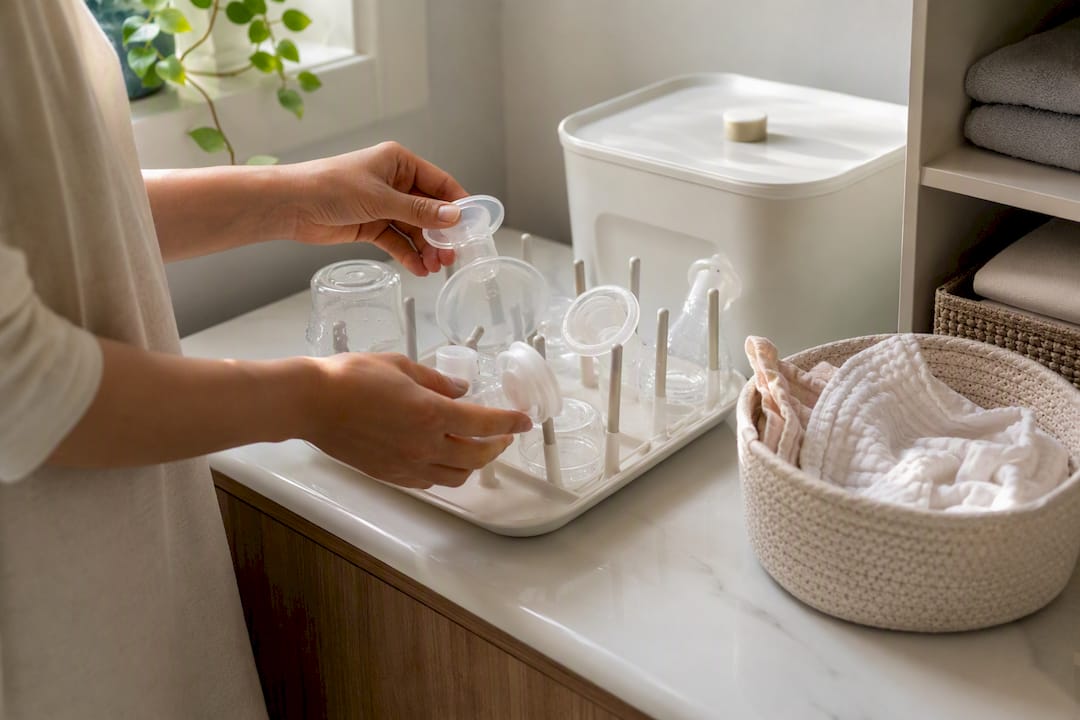
For waste, a small pedal bin with replaceable liners next to the bed beats walking used nappies to the kitchen at 3am.
Do a quick Sunday-night stock check: nappies, wipes, snacks, and clean pump parts, so you’re never caught short mid-week.
- Daily basket swap for cloths and pillow covers.
- Air-dry pump parts on a rack, then seal them in a container.
- Small bin with liners at the bedside, emptied every day or two.
- Weekly stock check for nappies, wipes, snacks and spare parts.
- Washable breast pads cut ongoing cost but need daily laundering; disposable pads reduce laundry but add to weekly waste. Most mums land on a mix of both depending on how the week’s going.
Three bedside breastfeeding setups you can copy tonight
Not every bedroom or recovery situation calls for the same layout. These three variations cover the situations that come up most often.
1. Small room, basket-on-chair. If your bedroom barely fits the bed and a lamp, skip the cart. Use a sturdy basket on a chair pulled close to your side, packed with immediate-reach items only: water, snacks, pillow, nappies, and wipes. Store backstock in the wardrobe and restock the basket every morning rather than trying to fit everything bedside at once.
2. C-section recovery. Raise your nursing pillow to reduce how far you need to lean forward, since twisting or bending to reach low items puts strain on a healing incision. Place change items on a shelf at hip height instead of the floor, and keep anything your partner might hand you (water, a fresh singlet) on the side they usually sit or stand.
3. Pumping-friendly setup. Pumping needs a stable table near a power outlet, not a wobbly nightstand. If you’re expressing overnight, a small insulated cooler beside the bed avoids a fridge trip in the dark; just move milk to proper storage the next morning.
Why ergonomics matter more than most nursing pillows admit
Most standard nursing pillows sit low and flat, which forces you to hunch your shoulders and curve your spine forward to bring your baby up to the breast. Do that for twenty minutes, six times a night, for weeks, and the strain compounds fast. It’s one of the most common (and most overlooked) causes of new-mum back and neck pain.
An 18cm lift pillow changes the geometry: it brings your baby up to your breast height instead of you dropping down to theirs. That extra height matters most for shorter mums, for side-lying alignment where a flatter pillow leaves a gap, and in smaller rooms where a low chair or lap height already puts you at a disadvantage.
Compression resistance matters just as much as lift. A pillow that flattens under a newborn’s weight within a few weeks stops doing its job exactly when you need it most, in the thick of nightly feeds. Breathable, machine-washable covers matter too, since a nursing pillow gets used daily and needs to survive frequent washing without losing shape.
- Higher lift reduces shoulder and neck hunching during long feeds.
- Compression-resistant foam keeps supporting baby’s weight after weeks of nightly use.
- Machine-washable, breathable covers handle the mess without degrading.
- Stability reduces the constant repositioning that interrupts a sleepy latch.
Pro Tip: For side-lying feeds, angle the pillow slightly rather than laying it flat. For upright feeds, slide it fully under your forearm so your elbow, not your wrist, takes baby’s weight.
How do you bring your partner into night feeds?
A bedside breastfeeding setup works better with two people running it, even if only one of you is doing the feeding. Milk supply is a solo job, but everything around it doesn’t have to be.
Give your partner a job that doesn’t require breasts: nappy changes, resettling baby after the feed, refilling your water bottle, or handling the burp cloth reset between sides. Agree on this division before the exhaustion sets in, not in the middle of a 2am negotiation neither of you will remember properly the next day.
If your partner sleeps on the other side of the bed, keep a duplicate set of nappies and wipes on their side too, so they’re not climbing over you to grab supplies. Some couples split night shifts entirely, with one parent handling early-night feeds (settling baby back down) and the other taking over from 2am. Others simply tag-team every feed, one nursing while the other resets the station for next time.
The goal isn’t equal effort at every single feed. It’s making sure one person isn’t running the entire operation alone for eight weeks straight.
How do you protect your own sleep with this setup?
The bedside breastfeeding setup isn’t just for the baby’s benefit, it exists to protect what little sleep you get between feeds. Every extra minute spent hunting for a nappy or walking to the kitchen for water is a minute stolen from actual rest.
Sleep when your baby sleeps, even during the day, rather than using that window to catch up on chores your station has already made lighter. A few short daytime naps do more for your recovery than one long stretch you’re waiting for and rarely get in the early weeks.
Keep the room dim and cool between feeds so your own body can drop back into sleep faster once a feed ends. If you’re pumping overnight as well as feeding, consider whether every session actually needs both, or whether you can combine one pump with a feed to buy yourself an extra uninterrupted stretch.
Ask for help earlier than feels necessary. A partner, a parent, or a friend taking one night feed so you get four uninterrupted hours is worth more to your recovery than almost anything else on this list.
What if latch or milk supply issues hit at night?
Latch problems tend to feel worse at 3am than they actually are, mostly because you’re exhausted and everything feels harder in the dark. A shallow latch, where baby’s mouth doesn’t cover enough of the areola, is the most common overnight issue and usually shows up as pinching pain rather than the deep tugging sensation of a good latch.
If the latch feels wrong, break the seal gently with a clean finger and try again rather than pushing through pain for the rest of the feed. Line baby’s nose up with your nipple so they tip their head back slightly to latch, the same alignment that matters for side-lying feeds.
Perceived low supply overnight is common and usually not a real supply problem. Feeding more frequently through the evening (cluster feeding) is a normal way babies boost supply for the next day, not a sign something’s wrong. If pain, supply concerns, or feeding difficulty persist beyond a few days, a lactation consultant can assess the latch directly, which is far more reliable than troubleshooting alone in the dark.
What bedding and positioning aids actually reduce strain?
The mattress underneath everything matters more than any pillow on top of it. A firm, flat mattress is non-negotiable for side-lying feeds, and it also makes upright feeding more stable, since a soft mattress lets your hips sink and pulls your spine out of alignment.
Beyond the mattress itself, a higher-lift nursing pillow is the single biggest comfort upgrade, because it removes the need to curl your body downward toward your baby. A firm back cushion or wedge propped behind you supports upright feeding for longer stretches without your lower back taking the load. For side-lying, a small rolled towel behind your own back (not baby’s) can stop you rolling backward mid-feed once you relax.
Skip anything soft and unsupportive marketed as a “neck massager safety in pregnancy” guide if it flattens within weeks. Test compression by pressing it firmly with your palm. If it doesn’t spring back within a second or two, it won’t hold shape after nightly use.
What lighting actually helps at night without waking anyone up?
Full-brightness lighting at 2am is one of the fastest ways to turn a quick feed into a 40-minute wide-awake session for both of you. The goal is enough light to check latch and nappies, not enough to trick either of your brains into thinking it’s morning.
A dimmable lamp set to its lowest warm setting works better than a bright white bulb, since warm, dim light disrupts melatonin production far less than cool or bright light. Touch lamps and small clip lights are worth having on the cart itself, positioned so you can reach them without sitting up fully. Motion-sensor night-lights in the hallway or nursery help for the walk to and from the cot, so you’re not flicking on a hallway light that wakes the whole house.
Keep your phone screen dimmed and on night mode if you use it to check the time, since scrolling under full brightness at 3am does more damage to your ability to fall back asleep than the feed itself ever will.
What actually gets used at 3am (and what doesn’t)
Most of what gets bought for a nursery setup never gets touched after week two. What survives is boring: water, a decent pillow, and nappies within reach. Everything else is negotiable, and it’s fine to add or remove things from your station as your routine settles.
Don’t aim for a perfect setup on night one. Iterate as you learn what your baby actually needs and what you keep forgetting to restock. And if a night goes sideways and you end up feeding on the couch with mismatched socks and no burp cloth in sight, that’s not failure. That’s just what the early weeks look like for almost everyone.
— Marietjie
Get the nursing pillow built for real bedside setups
Everything in this guide comes down to one problem most nursing pillows don’t solve: they sit too low, so you end up hunching toward your baby instead of bringing baby up to you. This nursing pillow is built with a significant lift specifically to fix that, with compression-resistant foam that holds its shape through months of nightly use, not just the first few weeks.

It suits mums setting up their first bedside station, mums recovering from a C-section who need to avoid leaning forward, and anyone feeding in a smaller room where a low chair or bed already puts them at a height disadvantage. The cover is breathable and removable for machine washing, which matters when a pillow gets used daily. A built-in pocket holds a phone or muslin cloth, and the handle makes it easy to move between rooms as your setup changes.
If your current pillow is flattening out or leaving you hunched over every feed, the nursing pillow is the place to start. Add a free pacifier clip chain to your order while you’re there, or check out shipping protection for peace of mind if you’re ordering ahead of your due date.
Sources
- Breastfeeding while lying down
- Eating well when breastfeeding (fact sheet) — Tasmanian Department of Health
- Side-lying breastfeeding: how to nurse lying down safely — Healthline
- Infant suffocation incidents related to co-sleeping or breastfeeding in the side-lying position — J‑STAGE
FAQ
What is the 3-3-3 rule in breastfeeding?
There’s no single, widely recognised clinical definition of a “3-3-3 rule” in breastfeeding. If you’ve seen it referenced online, treat it as informal advice rather than an established guideline, and check with a lactation consultant for anything specific to your feeding routine.
What is the 5-5-5 rule for breastfeeding?
The 5-5-5 rule is a postpartum recovery guideline, not a feeding rule: five days resting in bed, five days resting on the bed, and five days resting near the bed after birth. It pairs naturally with a bedside breastfeeding setup, since the whole point is keeping everything within reach so you don’t have to get up.
At what age is side-lying breastfeeding safe?
Side-lying breastfeeding can be practised from the first days after birth, provided you’re on a firm, flat mattress with no loose bedding and you stay awake through the feed. Safety depends on the setup and your alertness, not your baby’s age.
What is the 6-6-6 rule for breastfeeding?
There isn’t an established numeric rule in breastfeeding guidance. Some parents use informal memory aids, but for anything affecting feeding schedules or supply, it’s worth checking directly with a lactation consultant rather than following an unverified rule.
Does a nursing pillow actually help with night feeds?
A higher-lift nursing pillow reduces the hunching and shoulder strain that come from feeding at the wrong height, which matters more overnight when you’re already tired and holding position for longer stretches. It won’t fix latch issues on its own, but it does make the physical side of a bedside breastfeeding setup considerably more comfortable.