

Place your baby on their back on a firm, flat surface, and hold them upright for around 20 to 30 minutes after feeds. Skip the wedges, inclined sleepers, and crib elevation entirely. These tricks don’t reduce reflux and they carry their own safety risks. If your baby shows breathing trouble, poor weight gain, or won’t feed, call your GP.
TL;DR:
- Most reflux in babies is normal and peaks within the first few months, usually improving significantly by 6 to 12 months.
- Holding the baby upright for 20 to 30 minutes after feeds, burping frequently, and avoiding jostling can reduce night-time reflux episodes.
- Flat, firm sleep surfaces are safest, and wedges or inclined sleep positions are discouraged because they do not help and may worsen reflux or pose safety risks.
- Reflux fluid is nearly neutral pH for about two hours after feeding, meaning most discomfort is not caused by acid but by mechanical factors.
- Red flags like poor weight gain, projectile vomiting, or breathing difficulties require prompt medical evaluation, but routine reflux often improves with simple management.
Table of Contents
- Why baby reflux at night seems so much worse
- Practical steps to reduce night-time reflux disruption
- Safe sleep rules and why elevation doesn’t help
- When to see a GP or seek urgent care
- Feeding posture that makes night feeds less exhausting
- What to expect in the coming months
- An easier way to manage upright night feeds
- Sources
- FAQ
Why baby reflux at night seems so much worse
Reflux is not rare, and it’s rarely dangerous. It’s also almost always physiological, meaning it’s a normal side effect of a young digestive system, not a disease. It tends to peak somewhere in the first few months and settles down considerably by the time babies hit 6 to 12 months old.
What changes at night isn’t usually the reflux itself. It’s your awareness of it. During the day, you’re distracted, upright, moving around. At night, you’re lying next to a monitor, listening to every gulp and grunt, watching every feed. The last feed before bed tends to be a big one, baby goes horizontal not long after, and gravity stops helping.
Then there’s silent reflux, which doesn’t announce itself with visible spit-up. Instead it shows up as back-arching, sudden distress, or gulping and grimacing mid-feed. It’s genuinely uncomfortable for baby but it’s still usually managed the same conservative way as reflux you can see.
Practical steps to reduce night-time reflux disruption
Most of what actually helps comes down to timing and posture, not products. Here’s what tends to make the biggest difference:
- Hold baby upright for 20 to 30 minutes after every feed. This uses gravity to keep milk down and gives the stomach time to start emptying before baby goes flat. Public health guidance from Children’s Health Queensland backs this as a first-line strategy.
- Burp frequently, not just once at the end. Pausing mid-feed to burp reduces trapped air, which is often what triggers a reflux episode in the first place. A proper burping technique matters more than how long you spend doing it.
- Try smaller, more frequent feeds. A stomach that isn’t stretched to capacity has less to bring back up. If you’re bottle feeding, paced feeding (slowing the flow so baby controls the pace) achieves a similar effect. Total daily intake stays the same. You’re just spreading it out.
- Avoid jostling straight after a feed. No bouncing, no car trips, no handing baby off for a nappy change the moment the bottle’s empty. Keep it calm and still.
- Never use inclined sleepers or wedges for actual sleep. If baby dozes off in the car seat, pram, or swing, move them to a flat cot surface as soon as it’s safe to do so.
Pro Tip: Keep a dim lamp and a single feeding chair set up for night feeds rather than moving between rooms. Less light, less movement, and a consistent upright hold each time trains baby’s system into a calmer rhythm faster than constant repositioning does.
Something worth knowing: reflux fluid is close to pH neutral for roughly two hours after a feed, which means most of what you’re seeing (or hearing) isn’t actually acidic or painful in that window. A fussy, unsettled baby with reflux isn’t necessarily a baby in pain. Sometimes it’s just the discomfort of being newly horizontal with a full stomach.
Safe sleep rules and why elevation doesn’t help
Back-sleeping on a firm, flat mattress remains the safest sleep position for every baby, reflux or not. It reduces the risk of Sudden Infant Death Syndrome and, contrary to what a lot of tired parents assume at 2am, it does not increase choking risk, even during a reflux episode. Red Nose is explicit on this point because the fear of choking is exactly what drives parents toward the modifications that actually put babies at risk.
Wedges, head elevation, and positioners fall into that category. They’re marketed as reflux solutions but paediatric authorities discourage them because the evidence doesn’t support any benefit, and the risks (suffocation, rolling into an unsafe position) are real. Some clinicians go further: elevating the head can actually worsen reflux symptoms rather than easing them, according to guidance from Children’s Health Queensland.
- Flat, firm cot mattress, no pillows, no loose bedding.
- No wedges, no inclined sleep positioners, ever, for any baby.
- If baby falls asleep somewhere upright (car seat, swing, your arms), transfer them to the flat cot as soon as you reasonably can.
When to see a GP or seek urgent care
Most reflux needs nothing more than the feeding tweaks above and time. A smaller number of babies need a proper medical review, and it’s worth knowing what tips that scale.
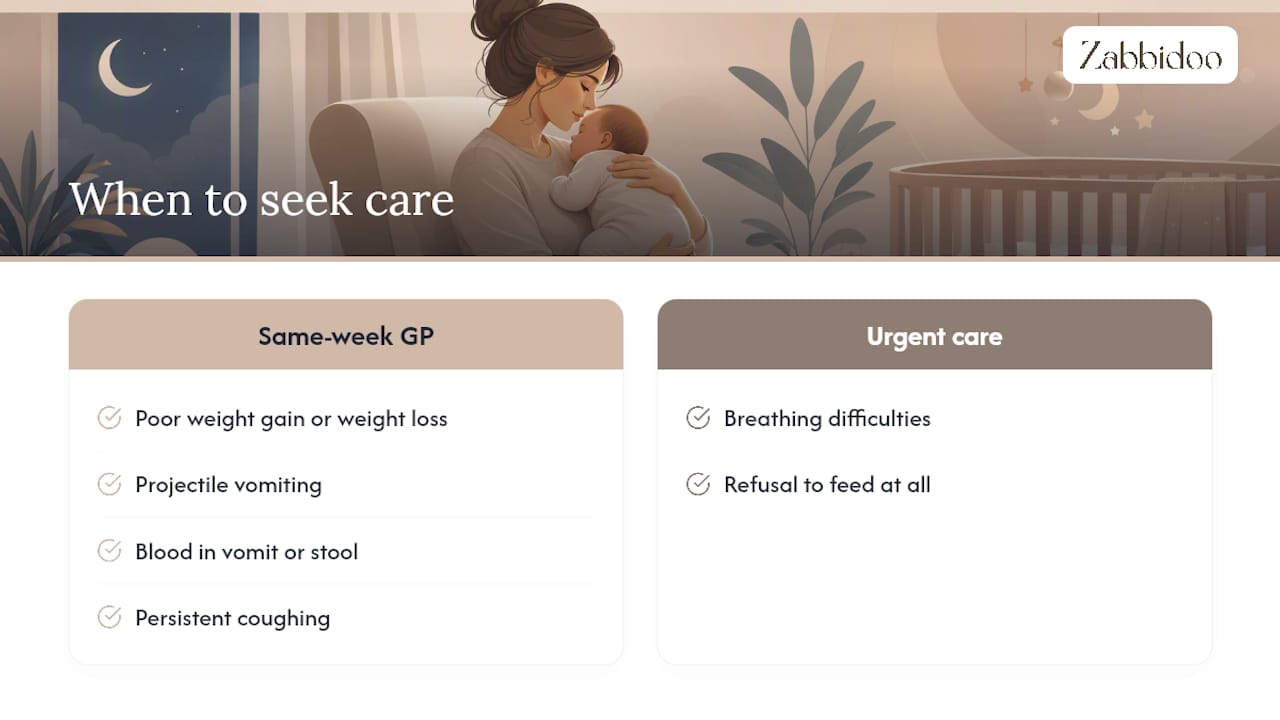
Red flags include poor weight gain or weight loss, projectile vomiting, blood in vomit or stool, breathing difficulties, persistent coughing, or a baby who starts refusing feeds altogether. Any one of these warrants a same-week GP visit; breathing difficulty or refusal to feed at all warrants urgent care.
Clinicians typically start with the same feeding adjustments outlined above before reaching for medication, and treatments like acid suppressants are usually reserved for infants with genuine complications rather than routine fussiness, per guidance from the Canadian Paediatric Society. Most infants don’t need scans or tests at all. Diagnosis is usually made from your description of symptoms and how baby responds to those simple changes.
Bring a rough feed and sleep log to the appointment; even two or three days of notes on feed times, volumes, and unsettled periods gives your GP far more to work with than “it’s been bad the last few nights.” A photo of a vomiting episode helps too, if you can manage it in the moment.
Feeding posture that makes night feeds less exhausting
None of this treats reflux medically, but posture changes how tiring those night feeds feel, and a tired, hunched parent makes for a less calm feed. Bringing baby up to your height rather than dropping your shoulders down to theirs matters more than it sounds.
- A stable, higher-lift nursing support keeps baby at chest height instead of you curling forward for twenty minutes at 3am.
- Firmer support means less repositioning mid-feed, which means less jostling right when you’re trying to avoid it.
- Upright side-lying holds and the classic “koala” hold both keep baby elevated for that post-feed window without straining your arms.
Zabbidoo built its nursing pillow around exactly this problem: most standard pillows compress and sag within weeks, forcing you back into a hunch. A stable, higher lift is a comfort and posture fix for you, not a treatment for baby’s reflux.
What to expect in the coming months
Reflux at its worst rarely lasts. Most babies improve noticeably by 6 months, and by 12 to 14 months it’s usually resolved outright. A simple feed and sleep log kept over a few weeks gives you (and your GP, if needed) a far clearer picture than memory alone. Trust the timeline, watch for the genuine red flags, and don’t let a few rough nights convince you something’s gone wrong.
— Marietjie
An easier way to manage upright night feeds
Zabbidoo’s nursing pillow is built to fix what most nursing pillows get wrong: they flatten out within weeks and leave you hunching over baby instead of bringing baby up to you. With an 18cm lift, a stable, compression-resistant core, and a breathable French flax linen cover you can machine wash, it’s designed to hold its shape through months of 3am feeds, not just the first few.

For reflux-prone babies specifically, that height matters. Keeping baby at chest level through the feed, and for the 20 to 30 minutes of upright holding afterwards, is far easier on your back and shoulders when the support underneath isn’t sagging halfway through. It’s not a medical fix. It’s a practical one that makes the nightly routine less punishing on your body.
If you’re weighing up whether your current setup is helping or working against you, the Nursing Pillow page has the full feature breakdown, including removable covers and a built-in pocket for muslins or a dummy. The pillow ships with a portable handle to make moving it between rooms easier.

Sources
For guidance beyond this article, Sydney Children’s Hospitals Network and Children’s Health Queensland both publish detailed reflux fact sheets. For safe sleep specifically, Red Nose remains the primary Australian authority.
This article is general information, not a substitute for advice from a qualified doctor. Consult a qualified healthcare professional about your own circumstances before acting on anything here.
- Gastro-oesophageal reflux (reflux) — Sydney Children’s Hospitals Network
- Reflux - Children’s Health Queensland
- Medical management of gastro‑oesophageal reflux in healthy infants — Canadian Paediatric Society
- Why should you sleep your baby on their back? — Red Nose
FAQ
Why does baby reflux seem worse at night?
It’s usually not worse, just more noticeable. Feeds before bed tend to be larger, baby goes flat soon after, and you’re lying awake hearing every gulp and grunt instead of being distracted by the day.
How do I help my baby with reflux at night?
Hold baby upright for 20 to 30 minutes after feeds, burp them frequently during the feed rather than just at the end, and always place them on their back on a flat, firm surface to sleep. Skip wedges and inclined sleepers entirely.
Does a dummy help with reflux?
A dummy can soothe general fussiness and settle a baby between feeds, but there’s no strong evidence it reduces reflux itself. If your baby is breastfed, wait until feeding is well established before introducing one.
What is silent reflux in infants?
Silent reflux causes the same discomfort as regular reflux, gulping, back-arching, distress mid-feed, without visible spit-up. It’s usually managed the same way, with feeding adjustments and upright holding, rather than needing separate treatment.