

Hold your baby close in a semi-upright position, head and neck supported, with the bottle nearly horizontal so the teat only half-fills. This lets your baby draw the milk out rather than have gravity push it in. The Royal Children’s Hospital and the Australian Breastfeeding Association both back this as the safest, most responsive setup. Never prop the bottle. Below, the exact holds, the step-by-step technique, and what to do when it goes sideways.
TL;DR:
- Using a semi-upright hold with the bottle tilted halfway ensures controlled flow and reduces overfeeding risks.
- Pausing every 3 to 5 sucks and observing the baby’s cues helps tailor feeding speed to prevent choking and gas.
- Never prop the bottle during feeding, as it increases choking hazards and impairs flow control.
- Proper positioning of both the baby and caregiver, supported by a high-lift nursing pillow, eases long-term paced feeding.
- Adjust teat flow and avoid rushing feeds, especially for premature babies or those with special needs, by consulting professionals.
Table of Contents
- What are the best positions for paced bottle feeding?
- How do you actually pace a bottle feed step by step?
- What safety mistakes should you watch for during a feed?
- Why does a good nursing pillow make paced feeding easier?
- What should you do if paced feeding isn’t going smoothly?
- What is paced bottle feeding actually trying to achieve?
- Why choose paced feeding over a standard bottle feed?
- How do you know if paced feeding is actually working?
- Does paced feeding change for premature or special needs babies?
- How do you choose bottles and teats suited to paced feeding?
- How can caregivers make paced feeding less stressful?
- A practical take on getting paced feeding right
- How Zabbidoo supports better paced feeds
- Sources
What are the best positions for paced bottle feeding?
There’s no single “correct” hold, but there are a handful that consistently work, and a couple you should avoid entirely. What they all share is a semi-upright angle and full head and neck support, because a flat or reclined baby has far less control over how fast milk arrives.
Semi-upright cradle hold. This is the default for most families. Sit your baby against your forearm at roughly a 45 degree angle, their head resting in the crook of your elbow, facing you. Keep their spine reasonably straight rather than curled or slumped. This position works for most babies from newborn through to the older bottle-fed infant, because it’s easy to read their face and adjust the bottle angle on the fly.
Upright hold. Baby sits more vertically, almost facing outward or slightly turned into your chest, often used once a baby has better head control (usually a few months in). It suits babies prone to reflux or who tend to gulp air, because gravity does less work pulling milk down and less air gets trapped.
Supported side-leaning position. Baby lies on their side against your body, head elevated, with your hand or forearm bracing their back. This reduces gravity-assisted flow further than the cradle hold, which is why it often suits newborns transitioning from breast to bottle or babies who choke easily on a faster stream.
Across-the-carer hold. Switching baby to your opposite arm partway through a feed (mirroring how you’d swap breasts) keeps the feed balanced and gives your arm a break without disrupting rhythm.
A few notes worth remembering:
- Skin-to-skin contact during a bottle feed calms most babies and slows the pace naturally.
- Slings, rockers, and bouncers are not substitutes for being held. They don’t offer the head and neck control paced feeding depends on.
- A fully reclined position (lying flat) is never appropriate for bottle feeding, propped or otherwise.
How do you actually pace a bottle feed step by step?
Once you’ve picked a hold, the technique is what makes it “paced” rather than just bottle feeding. It’s a sequence, not a single trick.
- Get set up first. Sit somewhere with back and arm support, a nursing pillow or cushion under your feeding arm if you use one, and check the milk temperature and teat flow before you start. A teat that’s too fast defeats the purpose before you’ve begun.
- Invite, don’t insert. Tickle baby’s upper lip with the teat and wait for them to open wide and reach for it themselves, rather than pushing it into a closed mouth.
- Keep the bottle horizontal. Tilt it just enough that the teat is half full of milk, half air. This is the single biggest lever you have over flow, according to Royal Children’s Hospital guidance.
- Pause every 3 to 5 sucks. Lower the bottle slightly so the teat drains and baby sucks on an emptier teat for a moment. This tiny pause is what gives your baby the chance to decide whether they want more, right now, and is the mechanism public-health feeding guidance points to for cutting down on overfeeding and gas.
- Watch, don’t just feed. Between pauses, check their face. Wide eyes and eager reaching mean keep going; slowed sucking, turning away, or splayed fingers mean stop or slow right down.
- Switch arms midway. This mirrors a breastfeed, keeps your body from tiring in one position, and gives you a fresh look at their face from a different angle.
- Burp when it feels right, not on a rigid clock. Some babies need it every few minutes, others only once.
- Finish upright. Hold baby upright for a few minutes after the feed rather than laying them straight down, and stop the moment they show fullness cues rather than pushing to finish the bottle.
Pro Tip: If your baby seems to be racing through the bottle, don’t just pull it away. Tip the bottle down so the teat empties of milk, let them keep sucking on air for a few seconds, then bring it back to horizontal. It resets the pace without a jarring stop.
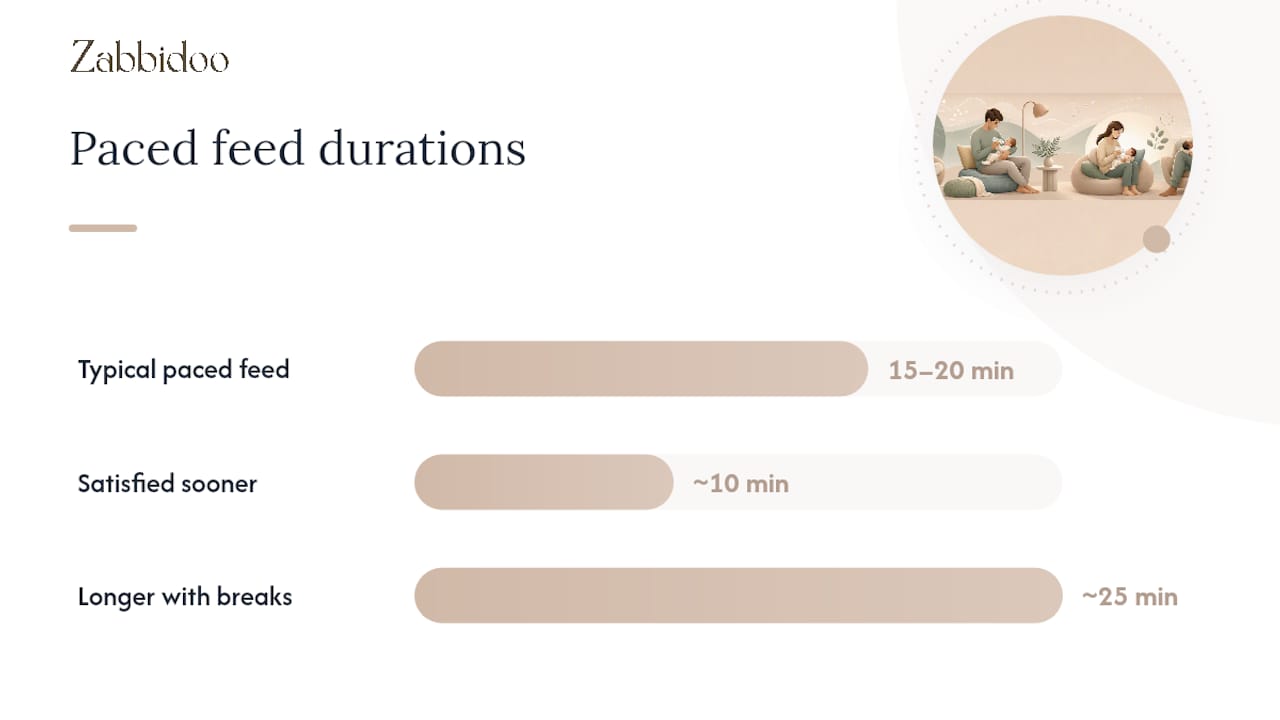
Most paced feeds run about 15 to 20 minutes, according to the Australian Breastfeeding Association, but that number is a guide, not a target. A baby who’s satisfied at 10 minutes has had enough. One who needs 25 minutes with plenty of breaks isn’t doing anything wrong either.
What safety mistakes should you watch for during a feed?
The single biggest rule in bottle feeding, paced or otherwise: never prop a bottle. Propping against a rolled towel, cushion, or bottle holder while baby lies unsupervised removes your ability to control flow entirely, and the NHS links propped feeding directly to choking risk and a higher chance of overfeeding.
Beyond that, a few common errors show up again and again:
- Ignoring fullness cues. Turning away, pushing the bottle out with the tongue, or falling asleep mid suck all mean stop, even if there’s milk left.
- Feeding flat or reclined. A lying-down position removes the gravity control that horizontal bottle holding is meant to provide.
- Wrong teat flow for baby’s age. A newborn on a fast-flow teat can’t out-pace the stream no matter how well you position them.
- Letting the teat collapse. If the teat flattens and needs tipping upright to refill, that’s usually a vacuum problem, not a hunger problem.
On that last point, a review of infant feeding mechanics found that steep bottle angles and flow mismatches are common causes of a flattened teat and excess suction. If it happens mid feed, don’t yank the bottle away. Slip a clean finger gently into the corner of your baby’s mouth to break the seal, re-latch, and check your angle before continuing.
Why does a good nursing pillow make paced feeding easier?
Your own posture affects how well you can hold a semi-upright position for 20 minutes without your arm going dead or your shoulders creeping up around your ears. Hunching forward to bring the bottle to a low baby, rather than bringing the baby up to a comfortable feeding height, is one of the most common (and least talked about) reasons paced feeding feels harder than it should.
A stable, higher-lift nursing pillow solves the actual problem: height. Zabbidoo’s pillow lifts baby 18cm, bringing them up to a comfortable chest height instead of you folding down to meet them. Because it resists compression, it holds that height through a full feed rather than flattening under baby’s weight ten minutes in, which is when most caregivers start unconsciously slumping and losing the semi-upright angle that makes flow control possible in the first place.
Setting it up is straightforward: fit the pillow around your waist while seated, position baby so their head sits just above the height of your elbow, and let the pillow’s stability do the work your forearm was doing alone. A hypoallergenic French flax linen cover means it wipes clean or machine washes easily after the inevitable spit-up.
Beyond the pillow, a short setup checklist helps:
- A slow-flow teat matched to baby’s age and sucking strength.
- A chair with proper back support, not the edge of a bed.
- A burp cloth within reach so you’re not scrambling mid feed.
- No slings, bouncers, or propped supports as a stand-in for being held.
Pro Tip: Keep the pillow at the same height every feed by using its built-in pocket to store a spare teat or dummy clip. Consistency in setup means less time repositioning and more time watching your baby’s cues.
What should you do if paced feeding isn’t going smoothly?
Most feeding hiccups have a fix that doesn’t require a call to anyone. A few common scenarios:
- Gulping, coughing, or milk dribbling out the sides. Slow the flow immediately by tipping the bottle more horizontal, pause more often, and double check the teat isn’t a size too fast.
- Baby refuses the bottle or turns away repeatedly. Try skin-to-skin contact first, offer smaller amounts more often, switch to a different hold, or try a softer, slower-flow teat.
- Frequent flattened teat or loud sucking noises. This usually points to a vacuum or angle issue rather than hunger. Break the seal gently at the corner of the mouth and reset.
Give any adjustment a fair trial across several feeds over 24 to 48 hours before assuming something’s seriously wrong. Babies are inconsistent by nature, and one rough feed rarely means a pattern.
If, after that window, you’re still seeing repeated choking, consistent refusal, or you’re worried about weight gain, it’s time to loop in your maternal and child health nurse, GP, or a lactation consultant. These aren’t failures on your part. They’re exactly the sort of thing feeding professionals are trained to assess quickly.
What is paced bottle feeding actually trying to achieve?
Paced bottle feeding is a technique built around one goal: giving your baby, not gravity or an eager caregiver, control over how much milk goes in and how fast. Traditional bottle feeding tends to run on a fairly constant flow until the bottle’s empty or baby’s clearly overwhelmed. Paced feeding breaks that flow into segments with deliberate pauses, so baby’s own sucking effort and swallowing determine the pace.
The core mechanism sits in that horizontal bottle angle and the regular pause. Global feeding guidance from the World Health Organization frames this as part of a broader principle: responding to hunger and fullness cues rather than following a rigid schedule or expecting a bottle to be finished. It’s the same philosophy behind demand breastfeeding, just adapted for a teat and bottle instead of a breast.
Worth noting: paced feeding isn’t really about making feeds slower for the sake of it. It’s about matching the mechanics of a bottle to the mechanics of breastfeeding, where a baby naturally controls flow with their own suck-swallow-breathe rhythm. Bottle feeds without pacing often move faster than a baby’s rhythm can keep up with, and that mismatch is where a lot of the downstream problems (gas, spit-up, overfeeding) tend to start.
Why choose paced feeding over a standard bottle feed?
The advantages show up in specific, observable ways rather than vague comfort claims. Reduced overfeeding is the headline benefit. When baby, not the bottle, sets the pace, they’re far more likely to stop when actually full rather than continuing because milk keeps flowing regardless of their signals.
Less gas and spit-up follow closely behind. A slower, paused flow gives babies time to swallow properly and breathe between sucks, instead of gulping air alongside milk in an attempt to keep up with a fast stream.
There’s also a bonding dimension that’s easy to overlook. Maternal and child health guidance from NCT points to eye contact, soft talking, and close physical contact during bottle feeds as genuinely important, and paced feeding’s slower rhythm naturally makes more room for that than a rushed feed does.
Perhaps most usefully, paced feeding preserves something breastfed babies get automatically: the connection between their own effort and the reward of milk. Bottle-fed babies given a fast, constant flow miss that feedback loop entirely. Clinical literature on infant feeding mechanics links flow-controlled feeding methods to better self-regulation over time, which matters well beyond the newborn months.
How do you know if paced feeding is actually working?
The signs are mostly in your baby’s face and body, not on a scale or a clock. A feed that’s going well usually looks calm: steady sucking with regular pauses, relaxed hands rather than clenched fists, and eyes that stay open and engaged rather than glazed or shut tight in apparent distress.
Good signs to look for include an even rhythm of suck, swallow, breathe without frantic gulping, a baby who calms during the built-in pauses rather than screaming for the bottle back, and clear signals when they’re done, like pushing the teat out with their tongue or turning their head away.
Signs it isn’t working tend to be louder. Milk dribbling from the corners of the mouth, frequent coughing or spluttering, a baby who seems to fight the bottle throughout the feed, or one who falls asleep exhausted rather than satisfied, all point to a mismatch somewhere, usually flow speed or positioning.
One thing to watch for that’s easy to miss: a baby who finishes a bottle unusually fast every single time, well under ten minutes, may simply be on too fast a teat rather than being an efficient feeder. Speed isn’t the goal here. A calm, cued feed is.
Does paced feeding change for premature or special needs babies?
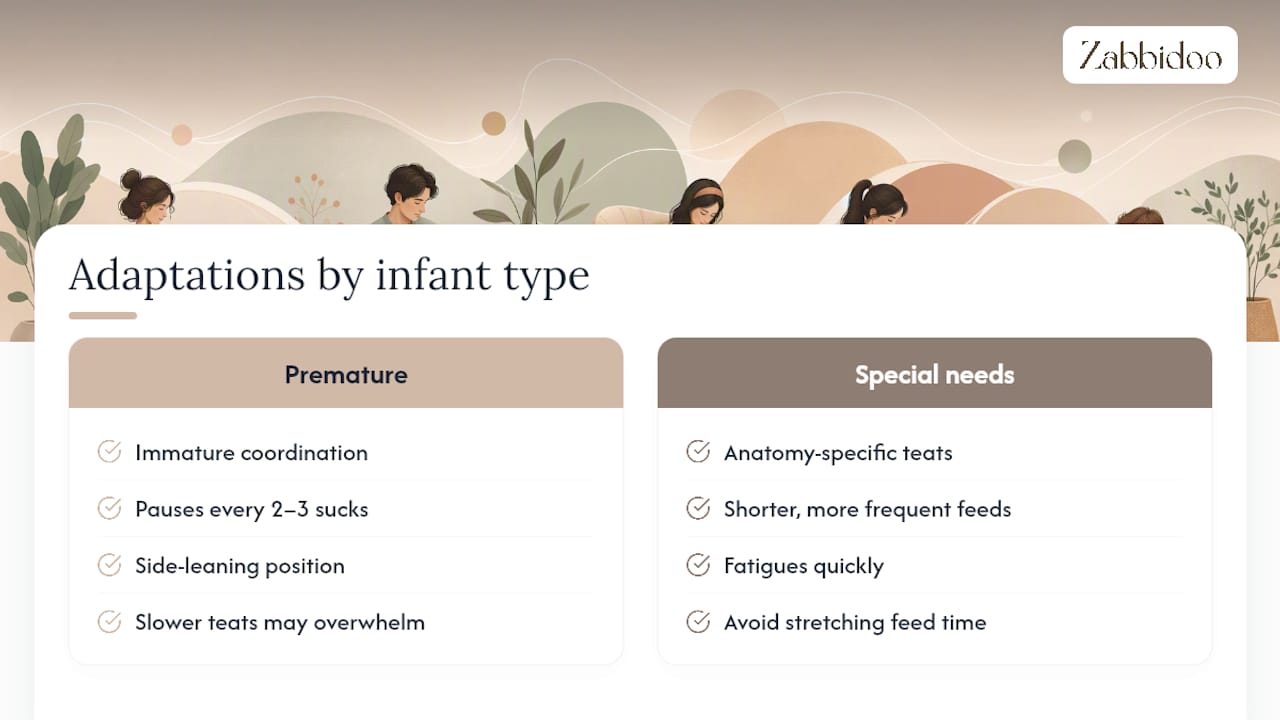
Premature and special needs infants generally need more, not less, of the control paced feeding is designed to offer, but the technique often needs adapting rather than applying as is.
Babies born early frequently have less mature suck-swallow-breathe coordination, so even slower-flow teats can overwhelm them. Extended pauses, sometimes every 2 to 3 sucks instead of 3 to 5, give these babies more breathing room. The side-leaning position tends to suit premature infants particularly well, since it reduces gravity-assisted flow further than an upright hold and mirrors some of the support they’d have had in a NICU feeding routine.
Babies with cleft lip or palate, low muscle tone, or cardiac conditions that make feeding tiring often need specialised teats designed for their specific anatomy, alongside shorter, more frequent feeds rather than trying to stretch to the usual 15 to 20 minute window. Fatigue shows up fast in these babies, and pushing through it tends to backfire.
None of these adaptations are something to work out alone through trial and error. A lactation consultant, feeding therapist, or the paediatric team already involved in your baby’s care is the right first call, because flow, position, and pacing all need fine-tuning specific to that baby’s medical picture rather than general advice.
How do you choose bottles and teats suited to paced feeding?
Not every bottle and teat combination supports paced feeding equally well, and getting this wrong undermines even perfect positioning.
Flow rate matters more than almost any other factor. A slow-flow teat, matched to your baby’s age and sucking strength rather than to how fast you’d like the feed to go, is the foundation of good pacing. If you’re constantly having to tip the bottle upright just to slow things down, the teat is too fast for that baby right now.
Vent design is worth understanding too. Anti-colic vents reduce the vacuum that causes a teat to flatten mid feed, which keeps flow steadier and reduces the little battles of re-latching. A wide, breast-shaped teat base often helps babies transition more smoothly between breast and bottle, since the mouth shape and latch feel more familiar.
Shape and firmness round out the picture. Some babies do better with a firmer teat they have to work slightly harder to draw from, which naturally slows their pace, while others need something softer to manage effectively. There’s genuinely no universal “best” teat, only the one that lets your particular baby control the pace comfortably. If you’re changing teats to solve a pacing problem, change one variable at a time so you can actually tell what worked.
How can caregivers make paced feeding less stressful?
Feeding stress is real, and it tends to spike hardest in the first few weeks when everything feels new and every choking splutter feels like an emergency. A few things genuinely help.
Set up before you’re desperate. Warming a bottle and settling into a supported chair before baby is frantically hungry gives you calmer hands and a calmer baby to start with.
Drop the finish-the-bottle mindset entirely. There is no reward for an empty bottle, and chasing one is where most feeding stress and most overfeeding both come from.
Trade off with a partner or support person where you can. Paced feeding takes patience, and patience runs thinner on broken sleep. Sharing feeds, even just some of them, protects everyone’s nerves.
Expect some feeds to be messy or slow, and don’t read too much into any single feed. Babies have off days like everyone else.
Finally, once solids and other fluids enter the picture later on, the same responsive, cue-led approach applies just as much to introducing drinks as it did to bottles, so the patient habits you build now carry forward.
A practical take on getting paced feeding right
Most advice on paced feeding focuses entirely on the baby’s mouth and the bottle angle, which is correct but incomplete. What gets skipped constantly is the caregiver’s own body. You cannot hold a stable, semi-upright, flow-controlling position for 20 minutes, multiple times a day, for weeks on end, if you’re hunched over a flattened cushion trying to bring a low baby up to your chest.
That’s the gap the standard advice leaves open. Positioning your baby correctly matters, but so does positioning yourself so you can actually sustain it feed after feed. A pillow that holds its lift and doesn’t collapse under weight isn’t a luxury add-on. It’s the difference between doing the technique properly for a week and doing it properly for months.
If there’s one thing worth prioritising above the rest, it’s this: get your own setup right first, then focus on baby’s cues. A comfortable, well-supported caregiver reads fullness signals far better than an exhausted one.
— Marietjie
How Zabbidoo supports better paced feeds
Every technique in this guide depends on one thing you can’t fake: holding a stable, semi-upright position long enough to actually watch your baby’s cues instead of watching your arm go numb. Zabbidoo’s nursing pillow is built for exactly that problem. Its 18cm lift brings baby up to a comfortable feeding height instead of you folding forward to reach them, and its compression-resistant fill keeps that height through a full 20 minute feed rather than flattening by minute ten.

The hypoallergenic French flax linen cover is machine washable, genuinely useful given how often bottle feeds end in spit-up, and the built-in pocket keeps a spare teat or dummy within reach so you’re not scrambling mid feed. It doubles for tummy time and general support once feeding season passes, so it’s not a one-trick purchase.
If your arm is already aching by feed three of the day, that’s the sign to fix your setup rather than push through it. Check out the nursing pillow and see whether the extra lift changes how sustainable paced feeding feels for you.
This article is general information, not a substitute for advice from a qualified doctor. Consult a qualified healthcare professional about your own circumstances before acting on anything here.
Sources
- Paced bottle-feeding — Australian Breastfeeding Association
- Bottle feeding — Royal Children’s Hospital, Melbourne
- Bottle feeding advice — NHS
- Infant and young child feeding — WHO