

Most mothers can keep breastfeeding after a shoulder injury by changing hold and support, not by stopping. The first move is simple: stop reaching or shrugging during a feed, prop your forearms on something stable, and bring the baby up to the breast instead of leaning down to them. If you notice numbness, weakness, or pain that’s getting worse rather than better, get medical review promptly rather than pushing through it.
TL;DR:
- Using a proper support setup before feeding prevents shoulder strain by eliminating the need for sustained isometric work during nursing.
- Modified positions like side-lying, laid-back, or rugby hold best protect an injured shoulder by reducing weight and awkward arm movements.
- Rehabilitative exercises focused on scapular control and thoracic mobility are crucial for safe recovery, done in short, frequent sessions rather than extended routines.
- Applying heat before feeds and cold afterward can help manage pain and inflammation, alongside avoiding unsupported sleep positions that aggravate shoulder issues.
- A firm, supportive nursing pillow with adequate lift and stability, such as the Zabbidoo Nursing Pillow, minimizes the risk of re-injury by maintaining proper posture and reducing compensation.
Table of Contents
- Which feeding positions protect an injured shoulder?
- How do you set up pillows and chairs to protect your shoulder?
- What exercises help you recover shoulder mobility safely?
- What actually eases pain during a feed?
- When should you get professional help?
- How do you keep feeding baby if your mobility is limited?
- What do physios say, and what should you look for in support gear?
- What does the shoulder anatomy have to do with breastfeeding pain?
- How do you start breastfeeding right after an acute shoulder injury?
- How do you manage the stress of an injury while caring for a newborn?
- How do you manage a shoulder injury that becomes chronic?
- How should you sleep to protect a healing shoulder?
- What’s the smartest way to think about this recovery?
- Give your shoulder a break with the right nursing pillow
- Sources
- FAQ
Which feeding positions protect an injured shoulder?
The wrong hold turns every feed into another rep of the movement that caused the injury. The right one takes the load off entirely, which matters more than most new mums realise when they’re troubleshooting shoulder pain while breastfeeding.
- Cross-cradle hold, modified. Rest your injured-side forearm along a firm cushion at breast height, palm up, and use your uninjured arm to guide the baby’s head. This keeps the injured shoulder still rather than asking it to hold weight.
- Side-lying. Lie on your uninjured side with the baby facing you, supported by a rolled towel or pillow behind their back. There’s no arm-holding at all, which makes it one of the safest options in the first fortnight after acute injury.
- Laid-back (biological nursing) position. Recline against cushions with the baby lying on your chest. Gravity does the holding, and your shoulders stay dropped rather than braced.
- Rugby hold. Tuck the baby under the injured arm, facing outward, supported on a pillow at chest height. This keeps that arm from crossing your body, which is the movement that tends to aggravate a strained rotator cuff or impinged shoulder.
If one side is genuinely off-limits for now, alternate: feed from the uninjured side directly and express milk on the injured side until strength returns. A side-lying feeding setup is worth practising even if you don’t need it every feed, because having a fallback position matters on the days pain flares unpredictably.
Pro Tip: Set up your position before you pick the baby up, not after. Repositioning mid-feed with a sore shoulder is exactly the movement pattern you’re trying to avoid.
How do you set up pillows and chairs to protect your shoulder?
The single biggest mistake mothers make with nursing pillows is using them to prop the baby and forgetting their own arms entirely. The Australian Breastfeeding Association points out that supporting your own back, shoulders and arms first, then bringing the baby to breast height, does more for shoulder pain than any positional tweak.
The sequence that actually works:
- Sit back into a chair with proper lumbar support so your spine isn’t doing extra work.
- Rest both forearms on a firm surface at breast height before you pick the baby up.
- Bring the baby to you. Never lean or hunch down to the baby.
- Check your shoulders are dropped, not raised toward your ears.
A chair with adjustable armrests helps if you have one, but most mums are feeding from a couch or a bed, which is where a dedicated support becomes genuinely useful rather than a nice-to-have. If a standard pillow collapses under the baby’s weight within a few minutes, you’re back to hunching to compensate, which reproduces the exact strain pattern you’re trying to fix. In the absence of a purpose-built support, stacking two firm cushions under a small towel can temporarily recreate the height and stability you need.
Pro Tip: If your elbow drops below your ribcage at any point during a feed, your shoulder is doing more work than it needs to. Reset before pain forces you to.
What exercises help you recover shoulder mobility safely?
Physiotherapy for nursing-related shoulder pain focuses on thoracic mobility and scapular control, not just “sitting up straighter.” Posture cues alone don’t fix a shoulder that’s lost range of motion or strength, which is why treatment protocols for mother’s shoulder typically combine thermotherapy, range-of-motion work, and muscle facilitation rather than rest alone.
Four starting points worth trying, or bringing to a physio to confirm they suit your specific injury:
- Pendulum swings. Lean forward slightly, let the arm hang, and swing it gently in small circles for 30 seconds. This restores movement without loading the joint.
- Scapular squeezes. Draw your shoulder blades together and hold for five seconds, ten reps. This rebuilds the control that stops shoulders from rounding forward during feeds.
- Thoracic rotations. Seated, rotate your upper back gently side to side to loosen the mid-spine that compensates when a shoulder is guarded.
- Isometric holds. Gentle resisted pushes against a wall, held briefly, rebuild strength without aggravating tissue that’s still healing.
Clinical guidance on upper-limb rehabilitation after injury favours pacing and graded loading over aggressive stretching. Stop immediately if you feel sharp pain, and fit these into two or three-minute windows between feeds rather than trying to find a dedicated session. If pain persists past a couple of weeks or you’re losing function, that’s the point to see a physiotherapist rather than keep self-managing.
Pro Tip: Do your scapular squeezes while you’re waiting for the kettle to boil. Rehab that depends on finding “spare time” with a newborn rarely happens.

What actually eases pain during a feed?
Heat packs before a feed loosen a stiff shoulder; cold packs afterwards calm inflammation once you’re done. Both are worth trying before reaching for medication.
- Apply heat for ten minutes before feeding to ease stiffness and improve range before you need it.
- Use a cold pack for fifteen minutes after a feed if the shoulder is inflamed rather than just tight.
- Take a genuine break between feeds. Loading breaks aren’t optional extras; they’re part of treatment.
- Ask a partner to bring the baby to you rather than lifting and carrying with the injured arm.
On medication, MedlinePlus lists paracetamol as generally compatible with breastfeeding, and ibuprofen is one of the most commonly recommended anti-inflammatories for nursing mothers, but individual circumstances vary. Check with your GP or pharmacist before regular use, particularly if you’re on other medication or have a health condition. Medication is an adjunct here, not the fix. A study of nursing mothers’ musculoskeletal pain found that pain affecting daily function needs actual treatment, not just something to numb it through.
When should you get professional help?
Certain symptoms mean stop self-managing and get assessed now:
- New numbness or tingling down the arm or into the fingers.
- Progressive weakness, especially if you’re struggling to lift or hold the baby safely.
- Severe pain that isn’t easing with rest, heat, or basic pain relief.
- Redness, fever, or a hot, painful lump in the breast, which points to infection rather than musculoskeletal strain.
- Pain that’s stopping you from caring for your baby day to day.
Phone your GP for medical review of the injury itself, a women’s health or musculoskeletal physiotherapist for a rehab plan, and a lactation consultant if latch or positioning still feels wrong despite the adjustments above. Bring specifics to the appointment: which movements hurt, what makes it worse, and what you’ve already tried.
How do you keep feeding baby if your mobility is limited?
- Combine short pump sessions with direct nursing rather than choosing one exclusively. Pumping on the injured side for a few minutes between feeds maintains supply without demanding sustained holding.
- If grip strength is reduced, rest the pump against a stable surface or ask someone to help position it rather than holding it unsupported.
- Let a partner or support person position the baby for latch on the harder side while you focus on staying still and relaxed.
- Use paced bottle-feeding for expressed milk if a feed needs to happen while you’re resting the shoulder completely.
- Return to full direct nursing gradually as strength and range improve, rather than switching back all at once.
What do physios say, and what should you look for in support gear?
Physiotherapy for nursing-related shoulder pain targets thoracic mobility and scapular control because posture correction alone rarely resolves pain that’s already established. Women’s health physiotherapists treat breastfeeding as a high-repetition task, similar to any repetitive strain injury, and assess it accordingly rather than dismissing it as “just how feeding feels.”
When choosing ergonomic support, look for genuine lift height, fill that resists compression under a feed’s worth of weight, and a stable base that doesn’t need constant repositioning. Zabbidoo’s nursing pillow was built around exactly this brief: an 18cm lift that brings baby up to you instead of you hunching down, and a stability-focused design intended to hold its shape rather than flatten out mid-feed.
What does the shoulder anatomy have to do with breastfeeding pain?
The shoulder is a shallow ball-and-socket joint held together mostly by muscles and tendons rather than bone, which is why it’s vulnerable to repetitive strain injuries in the first place. Four muscles, the rotator cuff, control most of the fine movement and stability; a bursa sac cushions the joint from friction, and this is the structure most often inflamed in what’s commonly called “mother’s shoulder.”
Breastfeeding puts specific, repeated demands on this anatomy. Holding a baby in a static position for twenty to forty minutes, several times a day, loads the rotator cuff and the muscles around the scapula (shoulder blade) in a way most daily activities don’t. If you’ve had a prior injury, dislocation, or rotator cuff strain, that joint has less stability margin to begin with, so the same feeding position that’s fine for another mother can aggravate an already compromised shoulder.
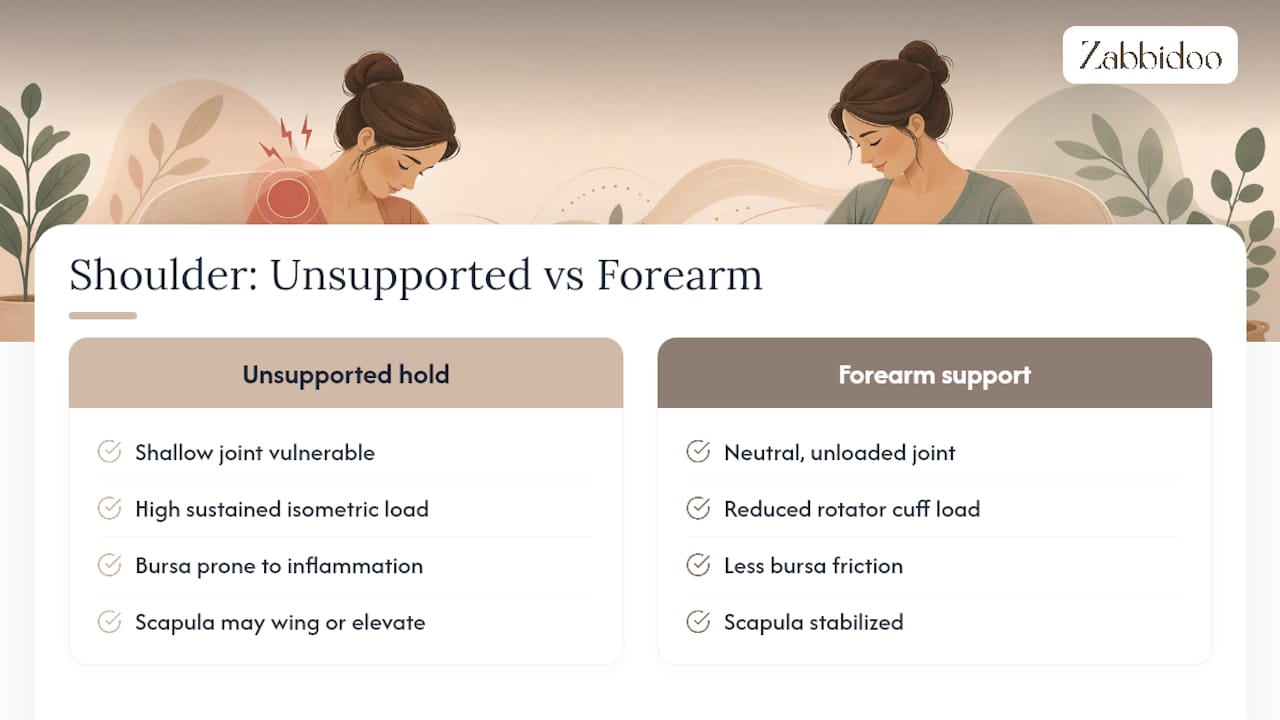
This explains why generic posture advice (“sit up straight”) only gets you partway. A shoulder recovering from impingement or a labral issue needs the joint kept in a neutral, unloaded position, which is a different requirement to simply improving spinal posture. Scapular control, keeping the shoulder blade stable and not letting it wing or elevate, matters just as much as where your spine sits. That’s the anatomical reason forearm support works: it removes the sustained isometric load on the rotator cuff and lets the joint rest in a position where it isn’t compensating for instability.
How do you start breastfeeding right after an acute shoulder injury?
In the first days after an acute injury, whether it’s a fall, a dislocation, or a surgical repair, the priority is finding a position that requires zero active holding from the injured side. Side-lying or the laid-back position are usually the safest starting points, because both let gravity and the mattress or your torso do the supporting work rather than your arm.
Get help positioning the baby for the first few feeds if at all possible. A partner, midwife, or lactation consultant can support the baby into place while you keep the injured shoulder completely still, which matters most in the acute inflammatory phase when extra movement does the most damage.
Keep sessions shorter and more frequent if a longer feed becomes genuinely painful, rather than pushing through discomfort to finish. If you’ve had surgery, follow your surgeon’s specific movement restrictions above any general breastfeeding advice, since some procedures require the arm to stay immobilised for a set period regardless of feeding needs. Discuss the feeding plan with your surgical team before you’re back home if you can, so there’s no conflict between the shoulder protocol and the feeding plan on day one. Pumping temporarily on the injured side while you nurse from the uninjured side is a legitimate short-term strategy, not a failure, if the acute pain makes any positioning on that side unsafe.
How do you manage the stress of an injury while caring for a newborn?
Recovering from a shoulder injury while caring for a newborn stacks two demanding things on top of each other, and the mental load of that combination is often underestimated compared to the physical one. Feeling frustrated, anxious about causing further damage, or low about not managing tasks you used to do easily are common reactions, not signs you’re coping badly.
Practical stress management here looks different to generic self-care advice, because the constraint isn’t time, it’s physical capacity. Lower the bar on non-essential tasks for a few weeks rather than trying to match your pre-injury pace. Ask specifically for help with lifting, carrying, and positioning, since those are the exact movements putting your shoulder at risk, and accepting help with them isn’t a concession, it’s part of the treatment plan.
If persistent low mood, anxiety, or feelings of being unable to cope last more than a couple of weeks, mention it to your GP alongside the shoulder review. Postnatal mental health and physical recovery are frequently treated as separate issues, but pain that limits your ability to hold and feed your baby has a genuine psychological weight, and naming that to a clinician gets you support faster than trying to push through alone.
How do you manage a shoulder injury that becomes chronic?
If shoulder pain is still present three months in, the goal shifts from acute care to long-term management, and that shift matters because the strategies are different. Ongoing physiotherapy review, rather than a single assessment, becomes the backbone of care, tracking whether strength and range are actually improving or plateauing.
Build a maintenance routine around the exercises that helped in the acute phase, scapular squeezes, thoracic rotation, gentle isometric work, but expect the dosage to increase gradually as tolerance improves rather than staying static. A physio can guide progressive loading so the shoulder keeps building resilience instead of just avoiding aggravation indefinitely.
Review your feeding setup periodically as your baby grows, since a six-month-old held in the same position as a newborn puts different demands on the shoulder simply because of added weight. What worked at six weeks may need adjusting by six months. If pain is still limiting daily function after several months of consistent rehab, ask about further investigation, imaging or a specialist referral, rather than assuming ongoing pain is just the price of breastfeeding.
How should you sleep to protect a healing shoulder?
Sleep position matters more than most new mums expect, because hours spent on an unsupported shoulder can undo a day’s worth of careful feeding technique. Avoid sleeping directly on the injured shoulder where possible; the sustained compression tends to aggravate bursitis or impingement overnight.
Sleeping on your back with a small pillow or rolled towel supporting the injured arm keeps the shoulder in a neutral position without pressure. If side-sleeping on the uninjured side is more comfortable, hug a pillow to keep the injured arm supported and slightly forward rather than letting it fall back and strain the joint. Avoid sleeping with the injured arm raised above your head, a common habit that stretches an already irritated shoulder capsule.

If night feeds happen in bed, set up your side-lying feeding position with the same care you’d use during the day rather than improvising half-awake. A poorly supported night feed is one of the more common ways shoulder pain gets worse rather than better, simply because it happens repeatedly while you’re too tired to notice bad positioning.
What’s the smartest way to think about this recovery?
Most advice on shoulder pain and breastfeeding still leads with generic posture cues, sit up straight, relax your shoulders, as if pain were purely a habit to correct. The research on nursing-related musculoskeletal pain says otherwise: this is frequently a genuine soft-tissue injury, bursitis, impingement, rotator cuff strain, that needs the same graded rehabilitation any repetitive strain injury gets in any other context.
That reframe matters because it changes what you prioritise first. Forearm support isn’t a comfort measure, it’s the mechanism that stops the injured structures from being reloaded every single feed, up to a dozen times a day. Posture correction without that support is treating the symptom while the cause keeps firing.
What I’d tell any mother reading this: fix the support setup before you worry about sitting up straighter. Get the height and stability right so your arms aren’t doing isometric work for forty minutes at a stretch, then layer in the scapular and thoracic exercises a physio recommends. Skipping straight to exercises while still feeding in a position that reinjures the shoulder is treading water, and it’s the single most common mistake in how this issue gets managed.
— Marietjie
Give your shoulder a break with the right nursing pillow
Zabbidoo built its nursing pillow around the exact problem this article keeps circling back to: most pillows collapse under a feed’s real weight, forcing you to hunch or reach to compensate, which is precisely the movement pattern that aggravates an injured shoulder.

A nursing pillow with sufficient lift brings your baby up to breast height instead of asking you to lean down, and a compression-resistant fill is designed to hold that height through a full feed rather than flattening quickly. If you’re shopping for support gear while recovering, check for three things: genuine lift height, fill that resists compression under load, and a stable base that doesn’t need constant readjusting mid-feed. A hypoallergenic, machine-washable cover matters too, given how often nursing gear gets used and cleaned in the newborn months.
If your current setup is making you hunch, reach, or shrug through every feed, it’s worth looking at the Zabbidoo Nursing Pillow directly and seeing whether the height and stability suit your recovery. You can also browse the full range at Zabbidoo if you’re weighing it up against what you’re currently using.
Sources
- Breastfeeding following spinal cord injury: a consumer guide / PMC
- Body aches and pains while breastfeeding — Australian Breastfeeding Association
- Shoulder pain in breastfeeding mothers – PhysioCraft
- Nursing mothers’ experiences of musculoskeletal pain — PubMed
This article is general information, not a substitute for advice from a qualified doctor. Consult a qualified healthcare professional about your own circumstances before acting on anything here.
FAQ
Does mother’s shoulder go away on its own?
For many mothers, yes, it eases with rest, better positioning, and targeted exercises over several weeks. Persistent cases usually respond well to physiotherapy that focuses on thoracic mobility and scapular control, rather than time alone.
Can a pinched nerve affect breastfeeding mothers?
Yes, a pinched nerve in the neck or shoulder can cause numbness, tingling, or weakness down the arm, which makes holding and positioning a baby harder. Numbness or progressive weakness is a red flag that warrants prompt medical review rather than self-management.
Is ibuprofen safe to use while breastfeeding?
Ibuprofen is commonly recommended as a suitable anti-inflammatory for breastfeeding mothers, though MedlinePlus advises checking current guidance for your situation. Speak with your GP or pharmacist before regular use, especially alongside other medication.
What’s the best breastfeeding position after a shoulder injury?
Side-lying and laid-back positions generally place the least demand on an injured shoulder, since gravity supports the baby rather than your arm. A modified cross-cradle with your forearm rested on a stable, well-supported surface also works well once you’re past the acute phase.
How does a nursing pillow help with shoulder pain?
A pillow with genuine height and stability lets you rest your forearms and bring the baby to breast height, instead of hunching or holding weight with a tired shoulder. The Zabbidoo Nursing Pillow is priced at $249 one-off and designed specifically around that lift and stability requirement.