

Yes, most back and neck pain from bottle feeding is preventable. Bring your baby to chest height instead of leaning down to them, support your lower back with a firm cushion behind you, and use a compression-resistant support under your baby rather than a soft, sagging pillow. NHS guidance backs this basic principle, support both parent and infant so neither of you is straining. Fix the height problem first. Everything else is refinement.
TL;DR:
- Supporting both parent and infant during feeding prevents strain, with height adjustment being the most critical fix to avoid back pain.
- Using a firm pillow or support under your baby at nipple level significantly reduces caregiver back strain more than other positional adjustments.
- Sitting in a backed chair with feet flat and keeping water and support items within arm’s reach helps maintain proper posture throughout feeds.
- Switching feeding holds between sessions and incorporating short stretches between long feeds can prevent muscular fatigue and improve comfort.
- An ergonomic pillow with compression-resistant fill and proper support is more effective than soft cushions for maintaining correct posture during feeding.
Table of Contents
- What to fix at your very next feed
- Which feeding holds are easiest on your back?
- How do you set up your feeding space to prevent strain?
- Stretches and self-care to undo the damage between feeds
- What does the research actually say about feeding posture?
- What I’d prioritise if you only have five minutes a day
- Why an ergonomic pillow beats a soft cushion for feeding support
- Where this advice comes from
- Sources
- FAQ
What to fix at your very next feed
You don’t need new equipment to feel a difference tonight. Most of the pain comes down to five things you’re doing (or not doing) right now, and fixing them in order matters more than fixing them perfectly.
- Sit in a backed chair, feet flat or on a footrest. A soft sofa arm or the edge of a bed gives your spine nothing to push against, so your lower back does all the work.
- Bring your baby up to you, not you down to your baby. Slide a firm pillow or a rolled towel under your forearm until your baby’s mouth sits roughly level with your nipple line. This is the single biggest fix, because most caregiver strain comes from an unsupported lower and mid back curving forward to close the gap, not from the baby’s weight itself.
- Drop your shoulders and tuck your elbow in. Rest your forearm fully on the support so your shoulder isn’t hiked up near your ear for twenty minutes straight.
- Alternate sides or holds between feeds. Pick a simple rule, such as switching arms every feed, so the same muscles aren’t loaded every single time.
- Take a micro-break every few minutes on longer feeds. Relax your shoulders, shift your hip angle, and reset your arm on the support. It sounds fussy, but it’s the difference between five minutes of static loading and forty.
Pro Tip: Set a phone reminder for the first week. New parents underestimate how long a “quick feed” actually runs, and by the time you notice the ache, you’ve usually been locked in one position for far longer than you realised.
Small, repeated adjustments beat one perfect setup you never quite manage to replicate. Aim for consistency over precision.
Which feeding holds are easiest on your back?
Not every hold puts the same load through your spine, and switching between two or three is more sustainable than mastering one.
- Side-lying: you lie on your side with your baby facing you, torso supported by a pillow along your own spine. This takes almost all upper-body load off your shoulders and back, though it’s better suited to slower, calmer feeds than a fussy or fast-feeding baby.
- Laid-back or reclined: recline into a chair or against cushions at roughly 45 degrees, with your baby resting semi-upright on your chest. It’s comfortable for longer feeds, but keep your baby’s head elevated enough to swallow safely rather than feeding fully flat.
- Football or clutch hold: your baby sits tucked under your arm at your side, supported by a pillow at elbow height. This one is genuinely useful after a caesarean or if you’re finding a straight-across cradle hold uncomfortable against your chest.
- Cradle and cross-cradle: classic and familiar, but the easiest hold to get wrong. If the support under your baby is too low, you’ll round your upper back to compensate every single time.
A pilot study on preterm infants found that side-lying position increased total intake compared with a semi-elevated position, with a statistically significant result (p=0.007), and choking episodes trended lower too, though that second finding didn’t reach significance. Whatever hold you choose, NHS guidance is consistent: keep your baby semi-upright for comfortable breathing and swallowing, and never feed lying flat on their back.
How do you set up your feeding space to prevent strain?
The chair you feed in matters more than most parents assume. Choose one with a solid backrest that supports your lumbar curve, not just something soft to sink into. Test it before you commit: sit down, bring your knees to roughly hip height, and check your feet reach the floor or a footrest without you sliding forward.
Your foot position affects your lower back more than it looks like it should. Knees slightly below or level with your hips keeps your pelvis in a neutral position, whereas dangling feet or knees jammed up high both tip your pelvis and load your lower spine.
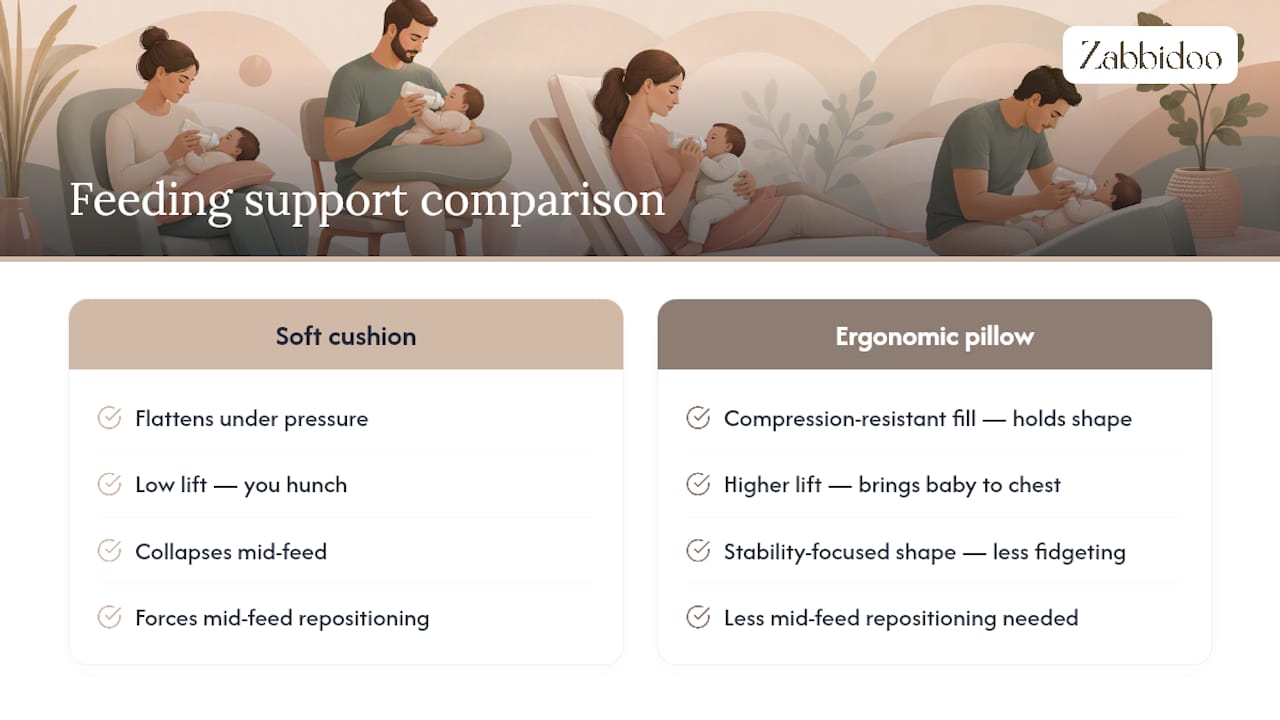
The support under your baby matters just as much as the chair under you. A compression-resistant support that keeps its shape through a whole feed means you never have to lean into the gap left by a cushion that’s gone flat halfway through. Soft pillows collapse under weight, so you end up hunching to compensate exactly when you’re most tired.
A few small additions turn a good setup into a repeatable one:
- Keep water within arm’s reach so you’re not twisting to grab a bottle mid feed.
- Set up a rolled towel or firm cushion as a backup for wherever you feed most (bedroom, lounge, nursery).
- If you’re cluster feeding, plan for brief standing or stretching breaks between sessions rather than staying seated for hours straight.
Stretches and self-care to undo the damage between feeds
Two minutes of movement, done consistently, does more than one long stretch session a week. Try these between feeds, not during them.
- Seated thoracic rotation. Sit tall, cross your arms over your chest, and gently rotate your upper body side to side, ten reps each way.
- Pelvic tilts. Lying down with knees bent, gently flatten and arch your lower back. If you’ve had a caesarean or a complicated delivery, check with your GP or physio before adding bridging.
- Chin tucks and scapular squeezes. Draw your chin back gently, hold, release. Then squeeze your shoulder blades together for five seconds. Both counter the forward head and rounded shoulder posture feeding creates.
- Doorway pectoral stretch. Forearm against a doorframe, gently rotate away, hold for twenty to thirty seconds each side.
Add a heat pack, a short walk, and slower breathing when things feel tight, and try not to sit in the exact same position for every feed of the day.
Pro Tip: If pain persists past a couple of weeks, worsens, or comes with numbness or tingling down your arm, that’s not something to stretch your way through. See a physio or your GP.
What does the research actually say about feeding posture?
NHS guidance is the clinical anchor here: support your baby semi-upright, and support your own arms and back so you’re not hunching over to compensate. A pilot study on preterm infants found side-lying positioning improved feeding efficiency, giving weight to the idea that position choice isn’t just about comfort, it can affect feeding outcomes too.
On the training side, a randomised trial on ergonomic breastfeeding training found mothers who received posture education reported far fewer back pain complaints at follow-up, 13.49% compared with 30.76% in the group that didn’t, a statistically significant difference. Biomechanical research on static postures backs the mechanism: sustained, unsupported positions cause muscular fatigue over time, which is exactly why varying your hold and taking micro-breaks isn’t just comfort advice, it’s the actual fix.
What I’d prioritise if you only have five minutes a day
The mistakes I see most: soft pillows that collapse mid-feed, feeding hunched on the edge of a bed, and staying locked in one hold out of habit. Fix your seat first, then bring baby up to you, then vary your hold. Add two mobility moves daily if you can manage it. If pain sticks around, get it checked early rather than pushing through it.
— Marietjie
Why an ergonomic pillow beats a soft cushion for feeding support
Zabbidoo exists because most nursing pillows do exactly the wrong thing under pressure: they flatten. A cushion that collapses mid-feed forces you straight back into the hunch you’re trying to avoid, which defeats the purpose of using a pillow at all.

The nursing pillow is built around a higher lift than most standard pillows, so your baby comes up to your chest instead of you folding down to them. It’s designed with compression-resistant fill that holds its shape through a full feed rather than sinking, and a stability-focused shape that means less mid-feed repositioning and less fidgeting to keep your baby supported. The cover is hypoallergenic, breathable and machine washable, and the pillow includes a built-in pocket and a portable handle for moving between rooms or out the door. It also doubles for tummy time once your baby’s a little older.
If you want to see the full nursing pillow range or read more about the design on the Zabbidoo site, current prices are on the pricing page.
Where this advice comes from
This guide draws on NHS bottle feeding advice, a preterm feeding position study, and a randomised ergonomic training trial on maternal musculoskeletal outcomes. For deeper reading on positioning and paced feeding, see this paced bottle feeding guide.
This article is general information, not a substitute for advice from a qualified doctor. Consult a qualified healthcare professional about your own circumstances before acting on anything here.
Sources
- Bottle feeding advice - NHS
- Study comparing semi-elevated and side-lying bottle-feeding positions (PMC)
- The influence of ergonomic breastfeeding training on health parameters in infants and mothers
- Biomechanical analysis of static postures and fatigue (Elsevier journal)
FAQ
Can holding a baby cause lower back pain?
Yes. Holding a baby in an unsupported position, especially leaning forward or hunching to bring your baby closer, loads your lower back with repeated static strain. Bringing your baby up to chest height with a firm support under them removes most of that strain immediately.
What are the common causes of back pain when feeding?
The biggest culprits are a chair without back support, a soft pillow that collapses mid-feed, and staying in one hold for too long. Research on breastfeeding-related musculoskeletal pain links sustained feeding positions closely to higher pain prevalence in mothers.
How do I fix back pain from carrying or feeding a baby?
Start with your seat: a backed chair with your feet flat or on a footrest. Then raise your baby to chest height using a firm pillow, keep your shoulders down and elbows supported, and vary your hold between feeds rather than repeating the same one every time.
Why does my back hurt when I feed my baby?
Your back hurts because you’re likely leaning down to your baby instead of bringing them up to you, which forces your lower and mid back to round forward for the length of the feed. A higher-lift support, like the one Zabbidoo’s nursing pillow is built around, closes that gap without you needing to hunch.