

Try the over-the-shoulder hold first: support your baby’s head and chin, hold them upright against your chest, and pat firmly at the mid-to-lower back for one to two minutes. Stop as soon as a burp comes up, your baby settles, or they vomit. The Royal Children’s Hospital supports upright holding after feeds, and Zabbidoo’s Marietjie has spent years watching what actually works at 2am.
TL;DR:
- Most babies respond best to upright burping positions that use gravity and a slight forward tilt to release trapped air, with over-the-shoulder and sitting on the lap being most common.
- Burping should be timed during feeding, especially every 60 to 90 milliliters, at switch points, and at the end, but forcing it on a settled baby can cause more harm than good.
- Supervised upright holding for 20 to 30 minutes after feeding may reduce reflux episodes in some infants, but sleep must always occur flat on a firm surface without inclines or props.
- The evidence supporting burping is limited, and some studies show no benefit or even increased regurgitation, so it is primarily a low-risk comfort measure rather than a necessity.
- Proper positioning, gentler patting, and avoiding force or prolonged efforts are key, especially for premature or medically complex babies who require tailored routines and shorter attempts.
Table of Contents
- Best upright burping positions and how to do them
- When should you burp a baby and for how long?
- Safe sleep rules and warning signs after feeding
- What does the research actually say about burping?
- Using a nursing pillow safely for upright burping support
- How do you know a baby needs to be burped upright?
- Common mistakes parents make when burping upright
- Alternative supports for burping beyond a nursing pillow
- Calming a fussy baby during a burping attempt
- Adjusting burping techniques for premature or special-needs babies
- Author’s perspective: pragmatic, baby-centred burping
- How Zabbidoo’s nursing pillow supports upright burping
- Sources
- FAQ
Best upright burping positions and how to do them
Three positions cover almost every situation you’ll face at feeding time, and each one works through the same basic mechanic: gravity and a slight forward lean push trapped air toward the top of the stomach, where it can escape more easily than when your baby is lying flat. MedlinePlus explains this is why upright posture matters more than the specific hold you choose.
- Over-the-shoulder: Support your baby’s head so their chin rests near your shoulder, then pat or rub firmly at the mid-to-lower back. Keep a cloth over your shoulder because spit-up happens exactly when you least expect it.
- Sitting on your lap: Support the jaw and chest with one hand, tip your baby forward slightly, and pat or rub at belly height with the other. This position lets you watch their face the whole time, which helps you catch discomfort early.
- Face-down across your lap: Keep the head higher than the chest and never let it dip below body level. This one works well when the other two haven’t produced a burp, but it demands constant attention to the airway.
- Walking or gentle bouncing: Some carers find movement helps dislodge a stubborn bubble, but only try this if you’re steady on your feet and your baby isn’t already distressed.
If nothing happens after a minute or two, switch positions rather than persisting with the same one. KidsHealth recommends this exact rotation, and a small comparative pilot study found sitting positions sometimes bring up a burp faster with less large-volume spit-up than shoulder holds. If your baby brings up more than a small amount of milk, stop and reassess rather than pushing on.
When should you burp a baby and for how long?
Timing matters more than technique. A baby who’s fed well but never burped isn’t a failure on your part. Not every baby needs to burp after every feed, and forcing the issue on a baby who’s already drifting off can do more harm than good.
Use these rules of thumb as your routine:
- Pause every 60 to 90 millilitres during a bottle feed and offer a burp attempt.
- Burp when switching from one breast to the other.
- Always try once at the end of a feed, whether breast or bottle.
- Give each attempt one to two minutes in a single position.
- If nothing happens, change position once, try again briefly, then let it go.
- Never interrupt a baby who’s settling happily just to chase a burp.
Burping exists to relieve obvious discomfort, not to tick a box. If your baby feeds, settles, and sleeps without a burp, that’s a good outcome, not a missed step.
Safe sleep rules and warning signs after feeding
Upright holding after a feed can genuinely help some babies. The Royal Children’s Hospital notes that around 20 to 30 minutes of upright holding may reduce reflux episodes for infants prone to spitting up. That guidance comes with a firm boundary: sleep always happens flat on the back, on a firm surface, with nothing propping your baby at an incline. A pillow or wedge used for unsupervised sleep is a genuine safety hazard, not a shortcut.
Statistic to remember: clinical guidance suggests roughly 20 to 30 minutes of supervised upright holding after a feed may help some babies with reflux, but this only applies while you’re actively holding them, not as a sleep position.
Watch for these signs that need prompt medical review rather than a longer burping session; knowing basic choking first aid can also help you respond quickly in an emergency.
- Blood or green bile in vomit
- Choking or gagging during or after feeds
- Any sign of breathing difficulty
- Poor weight gain over successive check-ups
- Refusal to feed
- Fever alongside feeding problems
If spit-up feels constant, keep a simple diary of feed times and volumes for a few days, then bring it to a clinician or lactation consultant. Patterns are far easier to assess on paper than from memory. The Royal Children’s Hospital also points out that crying alone shouldn’t be automatically blamed on reflux; plenty of healthy babies spit up and cry without anything being wrong.
What does the research actually say about burping?
Here’s the honest answer: the evidence for burping is thinner than most parenting advice implies. A review published in BMJ Paediatrics Open found that while burping is practised almost universally, robust comparative trials are scarce and the results that do exist are mixed. Some studies found no measurable benefit for colic symptoms. A few even recorded slightly more regurgitation in babies who were burped compared with those who weren’t.
So why do clinicians keep recommending it? Because a short, supervised burping attempt carries close to no risk, and for many families it genuinely eases both the baby’s discomfort and the carer’s anxiety. The same review notes that low-risk, low-effort interventions remain reasonable even when trial data is inconclusive, particularly when they’re paired with common sense rather than treated as a rigid ritual.
The practical takeaway hasn’t changed: try a brief upright hold when your baby seems uncomfortable, don’t force it when they’re settled, and get a proper feeding assessment if problems persist beyond what a diary and a bit of patience can explain.
Using a nursing pillow safely for upright burping support
A well-designed nursing pillow does more for burping than most parents expect, mainly by fixing your posture rather than your baby’s. Bringing a newborn to chest height without hunching forward reduces strain on your neck, shoulders, and lower back during those long feed-and-burp stretches. A nursing pillow uses an elevated lift to help bring your baby closer, reducing the need to hunch forward, and compression-resistant fill helps keep the shape stable instead of flattening mid-session like cheaper foam often does.
That support has limits, and they matter. A nursing pillow is never a sleep surface, an incline for an unsupervised baby, or a prop for a bottle left unattended. Feeding research on positioning and posture is consistent on this point: pillows help with posture and comfort during supervised feeding and burping, not as a substitute for a carer’s hands.
- Place the pillow at a height that brings your baby to chest level without you leaning forward.
- Keep one hand supporting your baby’s head and chest at all times, even with the pillow underneath.
- Switch positions if your baby becomes unsettled, rather than trying to force the same hold to work.
- Never leave your baby resting on the pillow unsupervised, awake or asleep.
Pro Tip: Use the pillow to support your forearms during the sitting-on-lap position, not just your baby’s body. Most of the strain in a long burping session comes from your own shoulders, not from holding your baby.
For safe setup and washing guidance, Zabbidoo’s nursing pillow safety guide covers the details worth knowing before first use.
How do you know a baby needs to be burped upright?
Some babies signal discomfort clearly. Others need you to read smaller cues. Squirming mid-feed, arching the back, pulling off the breast or bottle repeatedly, and sudden fussing after seeming settled are all common signs trapped air is bothering your baby.
A baby who pulls away, grimaces, or clenches their fists partway through a feed is often asking for a pause, not refusing the milk. Grunting or straining without an obvious cause can also point to gas rather than a full stomach. Watch, too, for a baby who feeds eagerly for a minute or two, then suddenly seems uncomfortable and won’t settle back onto the breast or bottle. That’s often trapped air rather than a change in appetite.
Not every fuss means gas. A baby who’s simply tired, overstimulated, or ready to finish the feed can look remarkably similar to one with wind. The difference usually shows in timing. Gas-related fussing tends to appear mid-feed or right after, while tiredness builds more gradually. If you’re not sure, a brief upright attempt costs you two minutes and tells you quickly whether it helps. If your baby settles the moment they’re upright and patted, that’s a strong sign gas was the issue all along.
Common mistakes parents make when burping upright
Patting too hard or too fast is the most common one. A firm, cupped hand delivers more useful pressure than a rapid, flat-palmed slap, and it’s gentler on a small back. Speed doesn’t help here. Consistency does.
Holding the same position for too long is another frequent misstep. Five or ten minutes in one hold rarely achieves more than one or two minutes did, and it risks winding up a baby who was close to settling. Switch positions instead of persisting.
Letting the head flop unsupported is a genuine risk, particularly in the face-down-on-lap position where it’s easy to focus on patting and forget the head needs constant support. Newborns don’t have full neck control until several months in, so a hand under the jaw or chest isn’t optional.
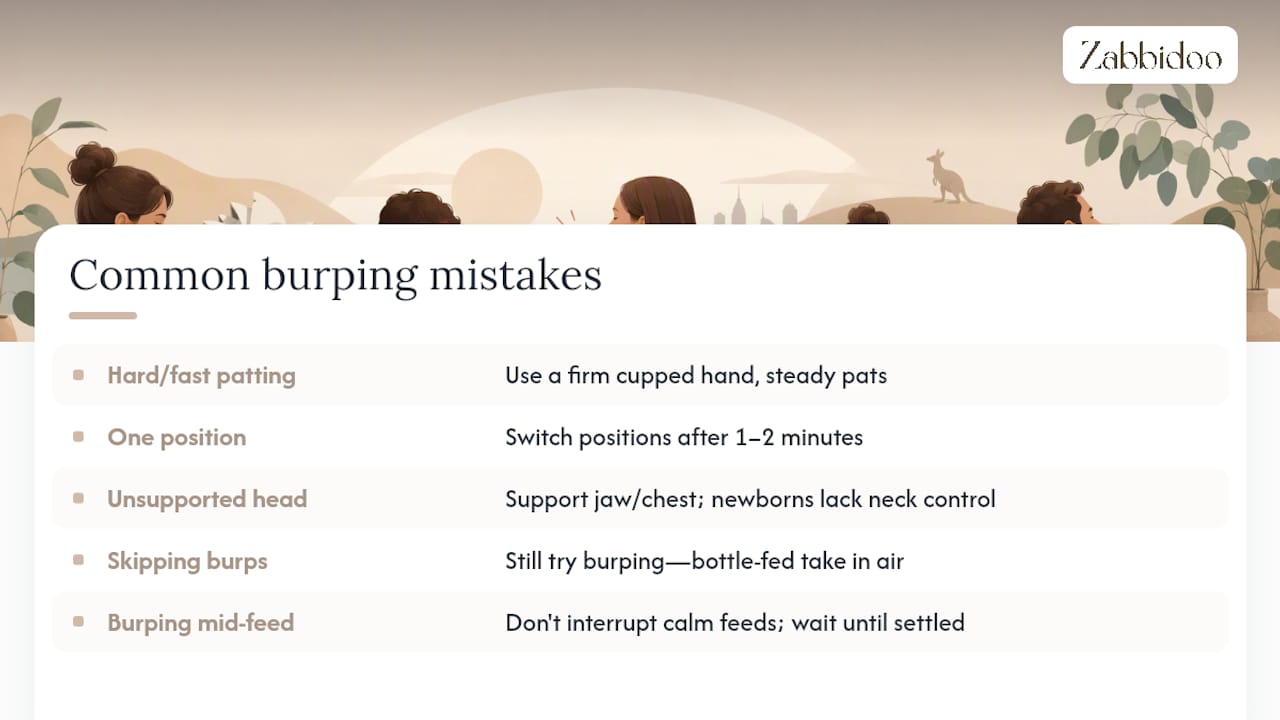
Skipping burping entirely because a baby “never seems to need it” can also backfire, especially with bottle-fed babies who tend to swallow more air than breastfed babies. And treating every cry after a feed as a burping problem leads plenty of parents down a loop of increasingly forceful patting when the actual cause might be tiredness, overstimulation, or nothing at all.
Finally, resist the urge to burp mid-feed when your baby is feeding calmly and well. Interrupting a settled feed to chase a burp that may not exist yet often does more to unsettle a baby than any trapped air would have.
Alternative supports for burping beyond a nursing pillow
A nursing pillow isn’t the only tool worth having within arm’s reach. A good burp cloth over your shoulder or lap saves your clothing and gives you a quick visual check on volume and colour if your baby does spit up, which matters for tracking patterns over time.
Baby slings and structured carriers offer a different kind of support for parents who need both hands free, since an upright, chest-to-chest position in a well-fitted carrier achieves much the same posture as an over-the-shoulder hold, just hands-free. This suits babies who settle better with the movement of walking rather than staying still.
UNICEF’s parenting guidance also suggests trying gentle tummy massage or slow bicycle leg movements if standard burping positions aren’t producing results, particularly for babies who seem gassy rather than genuinely needing an air bubble released. These aren’t replacements for upright positioning. They’re useful additions when burping alone isn’t cutting it.
A firm armchair with good back support matters more than people expect, too. Trying to burp a baby while perched on a low, soft couch usually forces you into the exact hunched posture that causes carer strain, regardless of what’s supporting the baby.
Calming a fussy baby during a burping attempt
A baby who’s already crying makes burping harder, because a tense, arched body doesn’t release trapped air as easily as a relaxed one. Slowing down usually works better than speeding up. Soft shushing, a slower and gentler patting rhythm, and a change of position can all help a fussy baby settle enough for a burp to actually happen.
Sometimes the fastest fix is putting the burping attempt on hold for thirty seconds. Rock gently, speak in a low, steady voice, and let your baby’s breathing slow before trying again. A baby in full distress rarely burps well no matter which hold you use, so calming comes first, technique second.
Dimming harsh lighting and reducing background noise during a burping session can also help, particularly with babies who overstimulate easily. If a fussy stretch is dragging on past several minutes with no improvement, it’s often more effective to move to a feed, a nappy check, or simple skin-to-skin contact rather than continuing to chase a burp. The Raising Children Network notes that a short attempt followed by observation tends to work better than prolonged patting that risks waking or upsetting a baby who was already close to settling.
Adjusting burping techniques for premature or special-needs babies
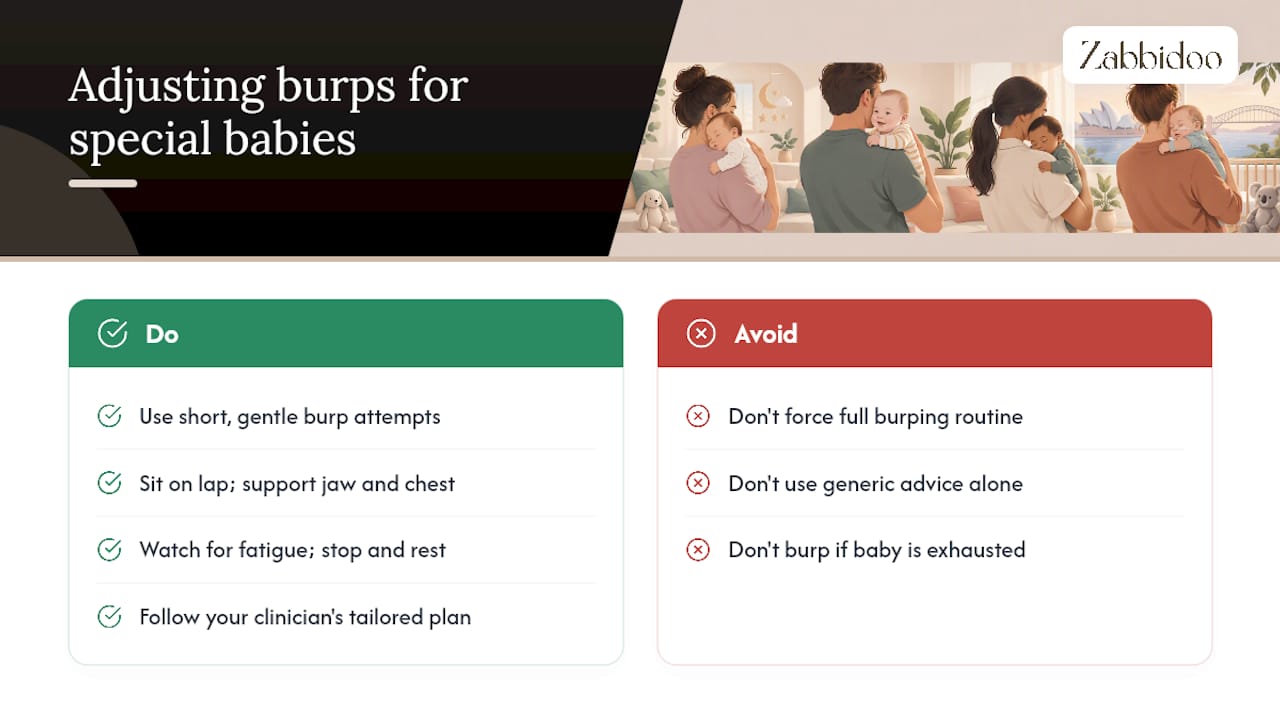
Premature babies often have less muscle tone and tire more easily during feeds, so shorter, gentler burping attempts matter more here than with a full-term newborn. The sitting-on-lap position, with extra hand support at the jaw and chest, usually works better than over-the-shoulder holds for babies who need more head and neck support.
Babies with reflux, feeding difficulties, or other medical conditions often benefit from a paediatrician or lactation consultant tailoring a specific feeding and burping routine, particularly around timing and position. What works for a healthy, full-term baby doesn’t always translate directly, and generic advice can miss issues specific to a premature or medically complex baby’s needs.
Watch fatigue signs closely with these babies. A premature infant who’s struggling to stay awake for burping may need a much shorter attempt, or none at all, followed by rest. Forcing a full burping routine onto an exhausted baby rarely helps and can add unnecessary stress to both of you.
If your baby has any diagnosed feeding condition, always follow guidance from your treating clinician over general advice like this. General techniques provide a useful starting point, but a paediatric team managing a specific condition will adjust timing, positioning, and frequency to your baby’s actual needs.
Author’s perspective: pragmatic, baby-centred burping
Plenty of babies burp just fine without any of this, and that’s worth saying out loud. A short attempt is usually enough. Watch how your baby feeds, grows, and settles overall rather than counting burps like a scorecard. If feeding problems keep showing up despite sensible adjustments, a clinician, lactation consultant, or Maternal and Child Health Nurse will get you further than another burping technique ever will.
— Marietjie
How Zabbidoo’s nursing pillow supports upright burping
Some nursing pillows address the common problem of hunching over a flat, collapsing cushion for long periods, which strains the back and complicates burping. An elevated lift design brings the baby closer to the parent rather than forcing the parent down to the baby, and compression-resistant fill can hold shape through multiple feeds rather than flattening quickly.

A breathable linen cover can improve comfort during longer feeding and burping sessions, and washable, hypoallergenic fabrics are convenient for managing spit-up and spills. As always, the pillow is a posture and support tool for supervised feeding and burping, never a sleep surface or a bottle prop. Keep a hand on your baby at all times. If you’re weighing up whether better ergonomic support would ease your feeding routine, the Zabbidoo Nursing Pillow page has the full specs, or you can check current pricing and availability on the Zabbidoo homepage.
This article is general information, not a substitute for advice from a qualified doctor. Consult a qualified healthcare professional about your own circumstances before acting on anything here.
Sources
- Reflux, GOR and GORD – Royal Children’s Hospital (RCH) kidsinfo
- How To Burp Your Baby — KidsHealth (Nemours)
- How to burp a baby — MedlinePlus
FAQ
Does holding a baby upright actually help reflux?
For some babies, yes. The Royal Children’s Hospital notes that around 20 to 30 minutes of supervised upright holding after a feed may reduce reflux episodes, though it isn’t a guaranteed fix for every baby and doesn’t apply once your baby is asleep.
What is the “Magic Burp” method?
There’s no single clinically defined “Magic Burp” technique in established paediatric guidance. If you’ve seen the term online, it typically describes a variation on the standard sitting or over-the-shoulder holds, so it’s worth sticking with the tested positions from KidsHealth rather than a specific branded routine.
Can a newborn sit upright for burping?
Yes, with full support. Newborns can’t hold their own head or trunk steady, so the sitting-on-lap position requires you to support the jaw, chest, and back the entire time rather than letting your baby sit unassisted.
What’s the safest way to try upright burping support?
Start with a short attempt in one position, supervise closely, and stop as soon as your baby settles, burps, or shows discomfort. Zabbidoo’s ergonomic pillow can support your posture during this process, but your hands stay on your baby throughout, every time.