

Essential breastfeeding habits for the first 0–3 months
The single most important thing you can do in those first weeks is feed often and respond to your baby’s cues before crying starts. Healthy newborns feed 8–12 times per 24 hours, roughly every 1–3 hours. That frequency is not a problem to solve. It is how your supply gets built.
- Feed on demand, not by the clock. Watch for rooting, hand-to-mouth movements, and lip-smacking rather than waiting for crying, which is a late hunger sign that makes latching harder.
- Practise exclusive breastfeeding unless medically advised otherwise. Avoiding pacifiers and bottles in the first few weeks protects your baby’s sucking technique and your supply.
- Prioritise a deep latch from the first feed. Your baby’s mouth should cover the areola, not just the nipple, with lips flanged outward.
- Expect cluster feeding during growth spurts. Let your baby set the pace and self-detach when finished.
- Monitor nappies and weight. Babies should return to birth weight by days 10–14; losing more than 10% signals a need for professional review.
- Drink water at every feed and eat regular, balanced meals to sustain milk volume.
- Hold your baby skin-to-skin as often as possible. Skin-to-skin contact stabilises infant physiology and keeps feeding cues active.
How to prepare for breastfeeding before your baby arrives
Preparation before birth makes the first days far less overwhelming. Learning what to expect means you spend less time panicking and more time feeding.
- Read about newborn hunger cues and typical feeding patterns so the frequency does not catch you off guard.
- Practise the main holds mentally: cradle, cross-cradle, football, laid-back, and side-lying each suit different situations. A C-section recovery, for instance, makes the football hold much more comfortable.
- Plan for immediate skin-to-skin after birth and discuss it with your midwife or obstetrician beforehand.
- Save the Australian Breastfeeding Association (ABA) number and the National Breastfeeding Helpline (1800 686 268) in your phone now, not at 3AM when you need them.
- Set up a comfortable feeding spot with good back support, a footrest, and water within reach. A quality nursing pillow is worth sourcing before birth, not after.
- Understand that frequent early feeding is what tells your body to produce milk. Supply follows demand, always.
Techniques that make the early days work
The first week is mostly about latch, position, and staying calm enough to let your baby lead.
- Respond to early hunger cues immediately. A calm baby latches far more easily than a distressed one.
- Use a baby-led latch: lie back, place your baby tummy-down on your chest, and let gravity and instinct guide them to the breast. This laid-back hold reduces the pressure on you and keeps your baby relaxed.
- Check the latch after each feed. Your nipple should emerge round and long, not flat or compressed. If it looks pinched, break the suction gently with a clean finger and try again.
- Aim for 8–12 feeds daily, including overnight. Night feeds are not optional in the early weeks; they are critical for supply.
- Manage engorgement with a warm compress before feeding and gentle massage to encourage let-down.
- Persistent pain with every feed is not normal. See a lactation consultant or IBCLC early rather than pushing through.
Pro Tip: Try the laid-back hold when you are exhausted or your baby is fussy. Gravity does most of the work, your baby’s instincts do the rest, and your back gets a break.
Common breastfeeding challenges and how to address them
Most mothers hit at least one rough patch. Knowing what is normal versus what needs help saves a lot of unnecessary distress.
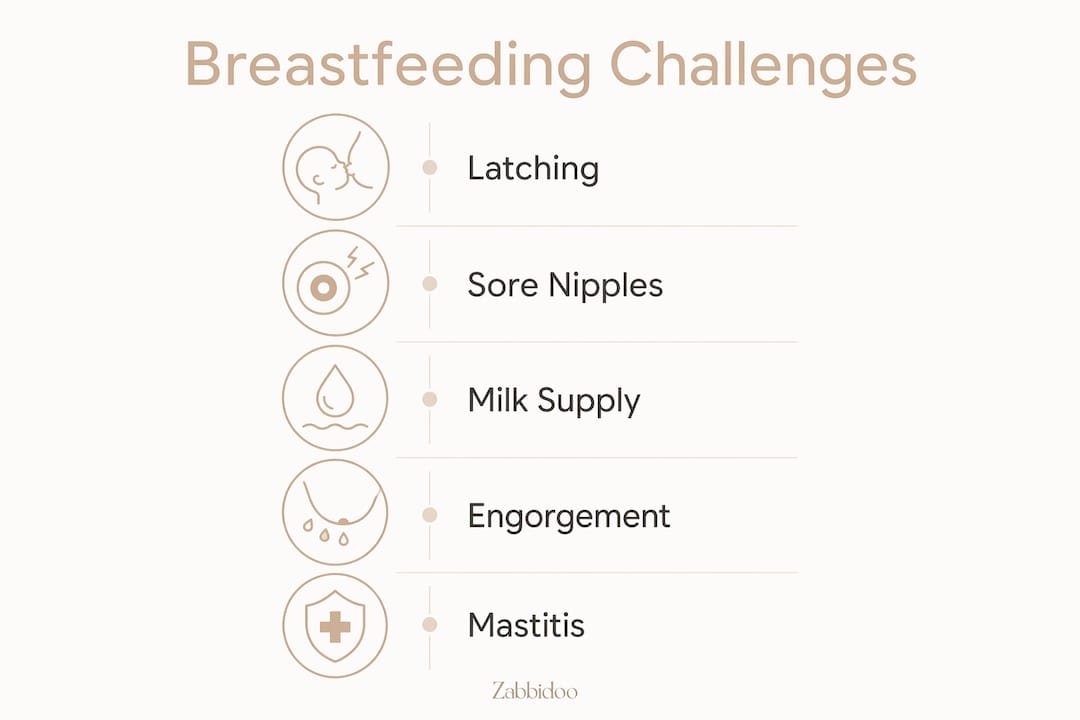
- Nipple pain: Usually signals a shallow latch. Reposition before the feed rather than tolerating pain. Expressed breast milk rubbed onto the nipple after feeding helps healing naturally.
- Engorgement: Feed more often, not less. Warm compresses before and cold packs between feeds reduce swelling. Expressing just enough to soften the breast makes latching easier for your baby.
- Mastitis: Fever, redness, and a hard, painful area in the breast need prompt medical attention. Keep feeding from the affected side; stopping makes it worse.
- Distracted or fussy feeding: Dim the lights, turn off screens, and reduce noise during feeds. Older babies get easily distracted; a quiet room fixes most of it.
- Cluster feeding: Normal during growth spurts. Resist the urge to supplement with formula unless your midwife or GP advises it, as supplementing reduces the breast stimulation that drives supply.
- Postpartum mental health: Breastfeeding difficulties and sleep deprivation compound low mood. Mothers with postpartum depression can usually continue breastfeeding. Talk to your GP or maternal child health nurse without delay.
For guidance on calming a fussy feeder, Zabbidoo’s practical guide covers the techniques that actually work in the moment.
Australian breastfeeding support resources you should know about
You do not have to figure this out alone, and in Australia, the support network is genuinely good.
- Australian Breastfeeding Association (ABA): Free counselling, peer support groups, and an extensive online library. The ABA Helpline operates 24 hours a day, seven days a week.
- National Breastfeeding Helpline (1800 686 268): Staffed by trained counsellors for urgent phone support at any hour.
- Mum2mum app: Tracks feeds, connects you with local peer supporters, and offers evidence-based tips. Particularly useful for logging nappy output and feed duration in the early weeks.
- Lactation consultants and IBCLCs: Hospital breastfeeding clinics and private IBCLCs can observe a full feed and identify latch issues that are invisible to an untrained eye.
- Maternal and child health nurses: Your local MCH nurse is a free, ongoing resource for weight checks, feeding concerns, and referrals.
- Breastfeeding in public: You have the legal right to breastfeed anywhere in Australia. No one can ask you to move or cover up.
Ergonomic posture and comfort during feeds
Poor posture during feeds is one of the most overlooked causes of neck, shoulder, and wrist pain in new mothers. Feeding 8–12 times a day adds up fast.
- Bring your baby to your breast, not your breast to your baby. Hunching forward is the root cause of most upper-back pain during nursing.
- Vary your position across feeds: cross-cradle for latch control, football hold after a C-section, side-lying for overnight feeds, and laid-back when you need to rest.
- A nursing pillow that holds its shape under your baby’s weight makes a real difference. Most standard pillows compress too quickly, forcing you to compensate by leaning down.
Pro Tip: The Zabbidoo nursing pillow sits at 18cm, which brings your baby to breast height rather than the other way around. The French flax linen cover stays breathable through long feeds, and the firm fill does not collapse mid-session the way softer pillows do.
For more on improving breastfeeding comfort, including position adjustments and pillow placement, Zabbidoo’s practical guide is worth bookmarking.
Safe breastfeeding practices and hygiene
Clean hands before every feed are non-negotiable. Wash thoroughly with soap and water, especially if you have been expressing or handling breast pads.

Breast pads, whether disposable or reusable, should be changed as soon as they are damp to prevent bacterial growth against the nipple. Reusable pads need a hot wash between uses. If you are using a breast pump, all parts that contact milk need sterilising after each session, particularly in the first three months when your baby’s immune system is still developing. Store expressed milk in sealed, food-grade containers and label them with the date.
Avoid applying scented creams or lotions to the nipple area. Your baby navigates to the breast partly by smell, and strong products can interfere with that. If you need a nipple cream, medical-grade lanolin or expressed breast milk are the safest options.
Pumping and storing breast milk
Pumping gives you flexibility, but timing matters. Expressing in the morning, when prolactin levels are naturally higher, tends to yield more milk with less effort.
Single or double electric pumps both work; a double pump cuts session time roughly in half. Aim to pump at the same intervals your baby would normally feed to maintain supply signals. Freshly expressed milk keeps at room temperature (up to 26°C) for 6–8 hours, in the fridge for up to 72 hours, and in a freezer for up to 3 months. Always use the oldest milk first. Thaw frozen milk in the fridge overnight or under warm running water; never microwave it, as hot spots can burn your baby’s mouth and degrade nutrients.
For postnatal recovery support that complements your feeding routine, Lunix has practical guidance on managing physical discomfort in the weeks after birth.
How breastfeeding affects sleep patterns
Breastfed newborns wake frequently because breast milk digests faster than formula. That is biology, not a sign that something is wrong.
Healthy newborns may sleep anywhere from 2–20 hours in the first days after the initial alert period, but still need at least 8 feeds in every 24-hour window. Night feeds are not just about hunger; they drive the prolactin surge that builds your supply for the following day. Side-lying feeding lets you rest while your baby feeds, which many mothers find genuinely sustainable through the newborn phase. As your baby grows and their stomach capacity increases, longer sleep stretches emerge naturally, usually somewhere between 6–12 weeks, without any need to restrict daytime feeds.
Key takeaways
Establishing strong breastfeeding habits in the first 0–3 months requires feeding 8–12 times daily, prioritising a deep latch, and accessing support early when problems arise.
| Point | Details |
|---|---|
| Feed 8–12 times daily | Newborns need feeding every 1–3 hours; this frequency builds your milk supply. |
| Watch for early hunger cues | Rooting and hand-to-mouth movements are easier to latch than a crying baby. |
| Return to birth weight by days 10–14 | Weight loss beyond 10% signals a need for professional review. |
| Vary your feeding position | Cross-cradle, football, laid-back, and side-lying each reduce different strain points. |
| Use Australian support networks | The ABA Helpline and Mum2mum app provide ongoing guidance specific to Australian mothers. |